
RV Converter and Inverter Repair · Cedar City, Utah
RV Converter and Inverter Repair in Cedar City, Utah: Get the Right Diagnosis First
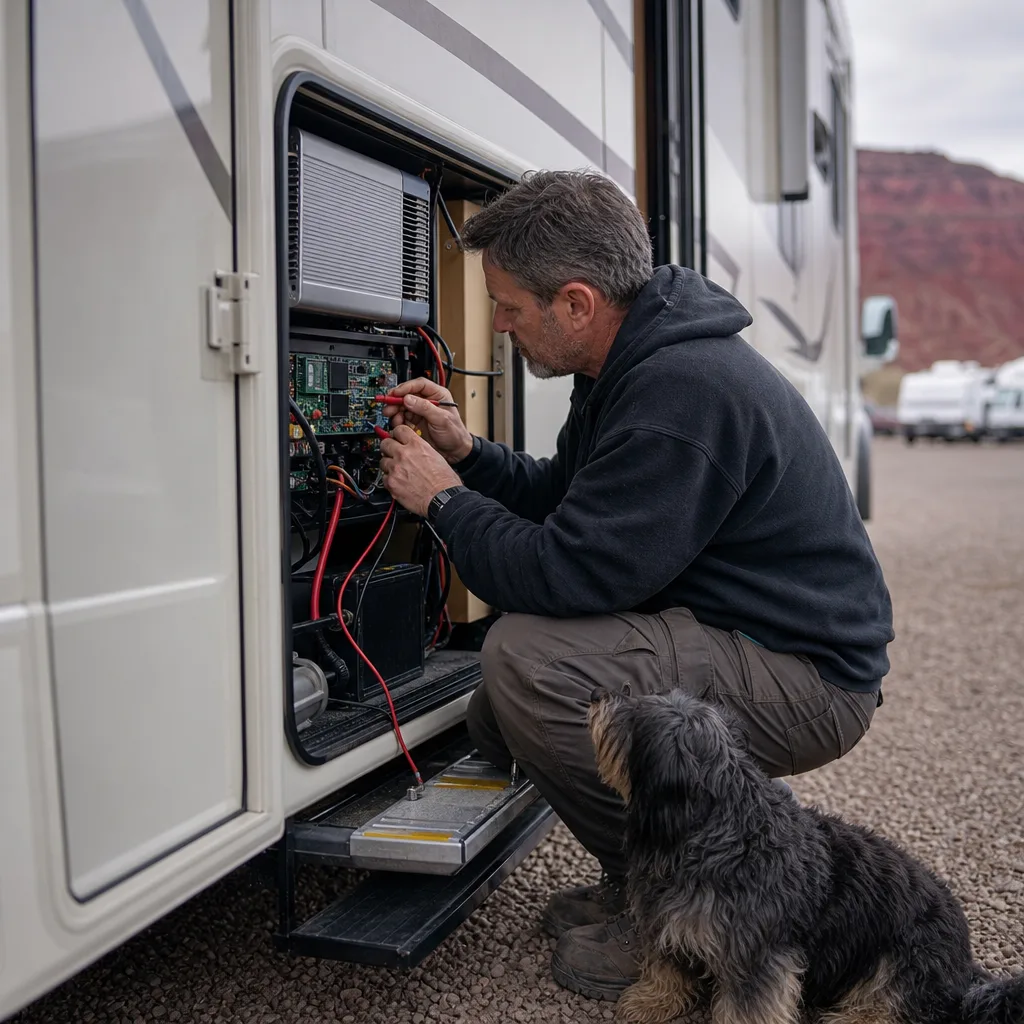
Converter Problems vs. Inverter Problems: Know Which One You Have
People mix these two up all the time, and the names don't help. They sound like twins. They're more like neighbors who work opposite shifts. Here's the plain version.
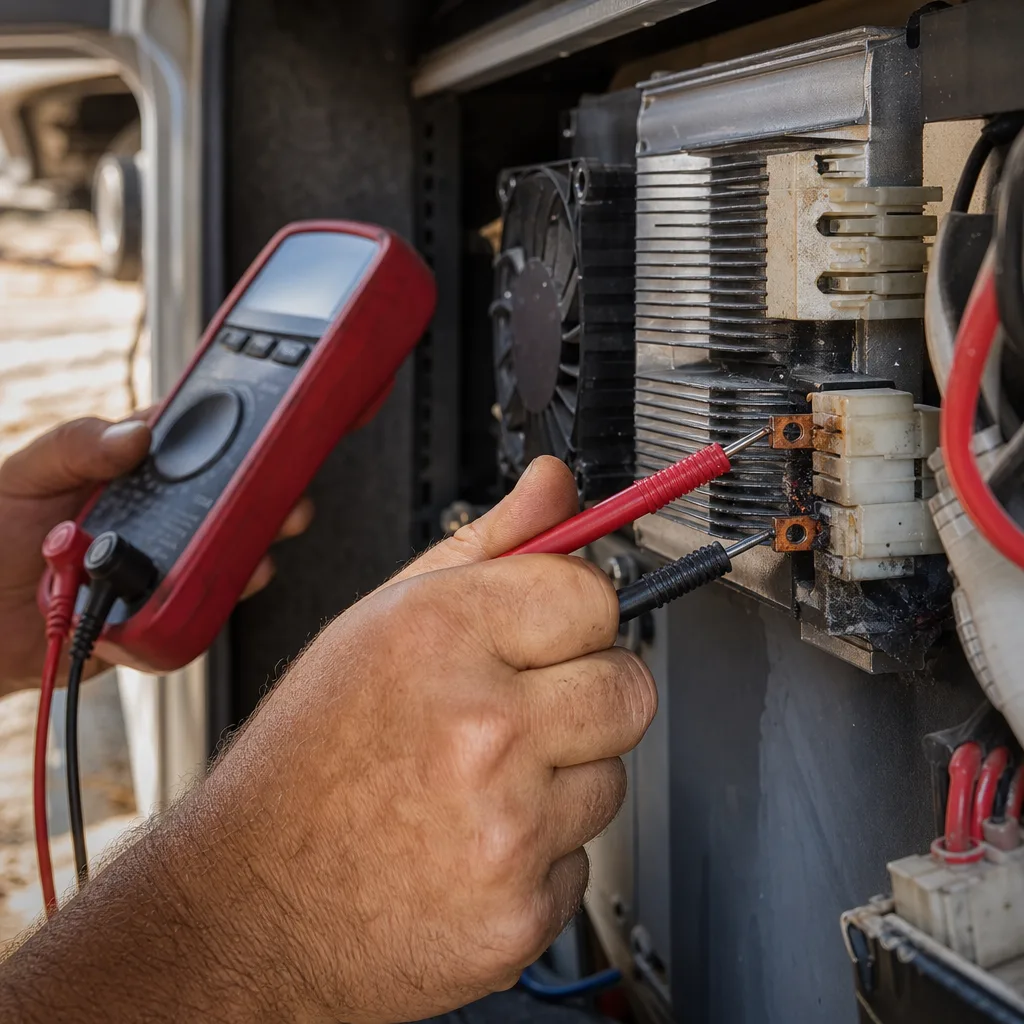
Your converter works when you're plugged in. It takes the 120-volt power from a campground pedestal or your house and turns it into 12-volt power. That 12-volt side runs most of your RV: ceiling lights, vent fans, the water pump, the furnace blower, and the control boards on your fridge and water heater. The converter also keeps your house battery charged. It's the quiet roommate you never think about until the dishes stop getting done.
Your inverter works when you're not plugged in. It takes 12-volt power from your battery bank and turns it into 120-volt power so your wall outlets, TV, or microwave can run without shore power or a generator. Not every RV has one. Many smaller trailers only have a converter, so if your outlets go dead when you unplug, that might just be how your rig was built.
Signs your converter is the problem:
- You're plugged in, but your battery still drains down overnight.
- Lights get dim or flicker, and fans run slow, even on shore power.
- Your furnace blower or water pump acts weak or quits when the battery gets low.
- Everything 12-volt works fine on the battery, then goes downhill after a day or two of being plugged in.
- You hear a cooling fan that won't shut off, a new buzz, or smell something hot near the power center.
Signs your inverter is the problem:
- Your outlets work on shore power but go dead the second you unplug, and your rig is supposed to have an inverter.
- Your battery is charged, but the TV or coffee maker won't turn on when you're dry camping.
- The inverter shuts off or beeps as soon as you turn on something that pulls a lot of power.
- A fault light or error code shows up on the inverter's display panel.
Here's where it gets tricky. A lot of newer rigs use an inverter/charger, which is one box that does both jobs. When that unit fails, you can lose charging and outlet power at the same time. That looks like two problems, but it's really one. Picture this: you pull into a site, plug in, and nothing charges. Then you unplug for a night of dry camping and the outlets are dead too. That's a classic combo-unit headache.
Also keep in mind that a tripped breaker, a popped GFCI outlet, a blown fuse, or a worn-out battery can look a lot like a failed converter or inverter. A tired battery is a big one. It can't hold a charge no matter how healthy the converter is, so the converter takes the blame for something it didn't do. That's why testing the whole 12-volt system matters before anyone swaps a part.
You don't need to diagnose it yourself. Just notice two things before you call: does the problem happen plugged in, unplugged, or both, and what stopped working? That alone tells our team a lot and gets you to a fix faster.
Check These Three Things Before You Call
Before you pick up the phone, spend ten minutes on these. We'd rather you fix it yourself for free than pay us to flip a switch. Plenty of 'dead converters' turn out to be a breaker that tripped when somebody ran the microwave and the hair dryer at the same time.
1. Follow the power from the pedestal to the panel.
- Start outside. Check the breaker on the campground pedestal or the outlet you're plugged into at home. Make sure the cord is pushed all the way in at both ends.
- Open your RV's power center and look at the 120-volt breakers. A tripped breaker can sit in a middle position that looks almost on. Push it fully off, then back on.
- Hunt down your GFCI outlets. They can be in the bathroom, the kitchen, or an outside compartment, and one tripped GFCI can kill several outlets down the line. Press reset firmly.
- If you have an inverter, check its on/off switch or remote panel. They get bumped off more often than you'd think, especially by kids and dogs.
2. Look at the 12-volt fuses.
Your 12-volt fuses usually live in the same power center, on the DC side. Pull any fuse tied to the circuit that quit and hold it up to the light. A blown one has a broken or melted strip inside. Many converters also have their own larger fuses right on the front of the unit, so look there too. Replace a blown fuse with the exact same amp rating, never a bigger one. If a fresh fuse blows again right away, stop swapping. Something on that circuit is pulling too much power, and that's worth a real diagnosis.
3. Give your battery an honest look.
This is the big one. A worn-out battery makes a healthy converter look guilty and makes an inverter shut down the moment you ask anything of it.
- Find your battery disconnect switch and make sure it's on. It's one of the most common 'my RV is dead' fixes there is.
- Check the terminals. White or green crust and loose cables can block charging even when the converter is doing its job.
- If you have a flooded lead-acid battery, check the water level. Low water ruins batteries quietly.
- Think about age. A battery that's several years old, or one that sat dead through a long storage season, may simply be done.
If you own a multimeter, read the battery voltage, then plug in and read it again after a few minutes. If the number doesn't climb, the battery isn't getting charged, and that points back toward the converter or charger. If it climbs but drops off fast once you unplug, the battery is the likelier problem. Our team handles RV battery replacement and testing too, if that's where this lands.
If all three check out and the problem's still there, you've done the easy part and ruled out the cheap stuff. Write down what you checked and what you saw. That saves time on our end and keeps anyone from charging you to re-find a tripped GFCI.
Signs the Problem Is Urgent, Not Just Annoying
Most converter and inverter trouble is a hassle, not a hazard. Dim lights and a dead outlet are annoying, but they won't hurt anybody. A few signs are different, though. When you see these, stop using the system and get help.
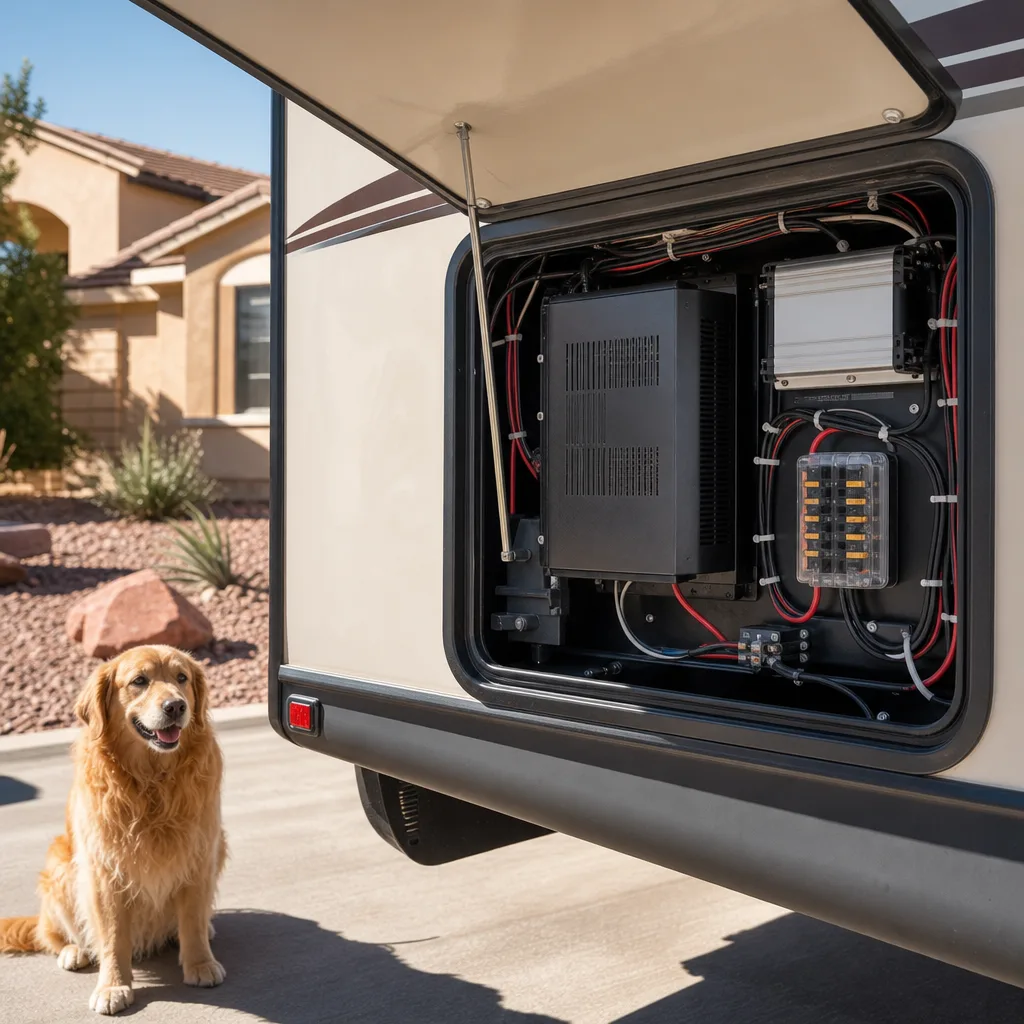
Heat, smoke, or a burning smell. If you smell hot plastic near the power center, see scorch marks, or feel a converter that's too hot to keep your hand on, don't wait to see if it settles down. Unplug from shore power, turn off the battery disconnect, and leave it alone. Electrical parts don't get better by cooking a little longer.
A fuse or breaker that won't stay put. One trip can happen to anybody. A fuse that blows again right after you replace it, or a breaker that keeps tripping, is the system telling you something is drawing way more power than it should. That's the point to stop resetting and start diagnosing.
A battery that's hot, swollen, or smells like rotten eggs. A converter that's stuck charging too hard can boil a flooded battery. You might hear bubbling, see a puffy battery case, or smell sulfur near the battery box. That's an overcharge, and it can ruin a battery fast and make a real mess. Turn off the charging source and keep sparks and flames away from it.
Your 12-volt safety gear goes dark. Your propane and carbon monoxide detectors run on 12-volt power in most rigs. So does the control board on your fridge, even when it's running on propane. If the converter quits and the battery drains, those can shut off without much warning. A dead detector isn't a someday problem when you're sleeping in the rig.
Cold nights with no furnace. Here's the Cedar City part. We sit up around 5,800 feet, and nights drop below freezing for a good chunk of the year. Your furnace burns propane, but the blower and the control board need 12-volt power. If a bad converter lets the battery die overnight, the furnace quits right along with it. Now you're not just cold. Your water lines and tanks are at risk of freezing, and that turns an electrical repair into a plumbing one. If you're camped in a cold snap and the battery is dropping on shore power, treat it as urgent.
For situations like these, our Emergency Mobile RV Repair service exists so you don't have to tow a rig with a fried power center across town.
Now the honest flip side. These can usually wait for a regular appointment:
- Your inverter won't run the outlets, but you're plugged in at a campground or at home and don't need it right now.
- One outlet or one light is dead, and everything else works fine.
- The converter's cooling fan is louder than it used to be, but there's no heat, smell, or charging problem.
- The battery runs down a little faster than it did last year, and the weather is mild.
None of those are fun, but none of them are dangerous. Write down what you're seeing, keep using what works, and book a time that suits you. A dead TV outlet isn't worth an emergency fee, and we'll be the first to tell you so.
How a Converter or Inverter Diagnosis Works
Here's the trap with these repairs. A new converter or inverter is easy to order, so it's tempting to swap the box and hope. Sometimes that works. Often you end up with a shiny new part and the same old problem, because the real culprit was a corroded ground, a loose cable, or a battery that gave up last spring. Spending money isn't the same as fixing anything. A good diagnosis tests the whole path the power travels before anything gets replaced.
That path is pretty simple once you picture it. Power comes in, gets changed, and goes out to your stuff. A solid diagnosis checks each of those three spots with a meter instead of a hunch.
- Power coming in. For a converter, that means confirming 120-volt power reaches the unit, not just the pedestal. For an inverter, it means checking the 12-volt power reaching it while it's running something. Undersized or loose battery cables can lose enough voltage under load to make a healthy inverter shut down and blame the battery.
- The unit itself. The converter's output gets measured with lights and fans off, then again with them on. A converter that reads fine at rest but sags under load isn't keeping up. Inverters often store fault codes, and those codes point you in a direction. They don't give you a final answer.
- Power going out. Grounds, connections, the transfer switch, and the battery all get checked under load. A battery can show a decent voltage sitting still and then fold the moment you ask it to work, like a guy who swears he's in shape until the stairs show up.
Combo inverter/chargers need one extra step. The charging side and the inverting side should each be tested separately. One box can fail at one job and still do the other just fine, and knowing which side failed changes what you're fixing.
Once the testing's done, the answer usually lands in one of three places. Maybe it's a wiring or connection fix. Maybe it's a single part inside the power center. Or maybe the unit really is done and replacement makes the most sense. You should hear which one it is and why, in plain English, before you spend a dollar on parts. If a tech can't tell you what they measured, ask. It's a fair question.
That's how we like to work. I'm an RVTI Certified Technician with more than 15 years in the RV industry, and Benny's RV is a mobile service. That means we bring the diagnosis to your rig, whether it's at a campsite, in your driveway, or on a storage lot. We don't ask you to drag a trailer with a sick power center across Cedar City. And because this is the 12-volt system, we look at the whole thing, not just the box with the blinking light.
On-Site Repair at Your Home, Storage Lot, or Campsite
Your rig doesn't have to go anywhere for this repair. Since the power center, the battery, and the shore power cord all live on the rig, the work happens where the rig is sitting. A little prep on your end makes the visit go smoother and keeps the clock from running while someone digs for a gate key.

Here's what helps most:
- Tell us if there's power where the rig is parked. A converter has to be tested on 120-volt power, and plenty of storage lots don't have an outlet anywhere near your spot. If yours doesn't, say so when you book so we can plan around it.
- Clear a path to the equipment. Converters and inverters like to hide under the bed, behind the steps, in a pass-through bay, or under a dinette seat. If it's buried under camp chairs and three seasons of fishing gear, pull that stuff out ahead of time.
- Sort out access. Have your storage lot gate code, unit number, or any check-in rules ready. At a campground, a quick heads-up to the host never hurts.
- Grab the basics. Know the year, make, and model of your rig. If you can, snap a photo of the label on the converter or inverter.
- Bring your notes. Whatever you found in the three checks above, and whether the trouble shows up plugged in, unplugged, or both, saves real time.
Now for cost. Mobile RV electrical work usually breaks into a few pieces. There's the time spent getting to you and running the diagnosis, then the repair itself, then parts. What pushes the bill up or down is mostly what the testing finds.
- A loose cable or a corroded ground is mostly labor and costs the least.
- A single failed part inside the power center lands in the middle.
- A full replacement unit costs the most. An inverter/charger usually costs more than a basic converter, and bigger inverters cost more than small ones.
- Hard-to-reach installs take longer. So does any work that needs heavier cables or a new mounting spot.
- If the battery turns out to be the real problem, that becomes its own line item.
Before you hire anyone, ask a few plain questions. Is there a trip or diagnostic charge? Does it count toward the repair if you go ahead? Will you get the findings and a parts estimate before work starts? A good tech won't mind any of these. If someone gets prickly over a fair question, that tells you something too.
When you reach out, you'll get one of two people. I'm the lead technician and your main point of contact, so you're talking to the guy who'll put a meter on your rig. My wife runs the office. She sets the appointments, keeps the calendar straight, and sends the invoices, so nothing falls through the cracks between the call and the fix.
If your battery won't charge on shore power or your outlets die the minute you unplug, it's time to stop guessing. Get the whole system tested where your rig sits.
Call nowFrequently Asked Questions
Can I run a small solar and inverter setup instead of a generator at my campsite?
Yes, many RVers use a solar panel, battery bank, and inverter to power small loads without a generator. Your inverter changes battery power into regular outlet power, so solar just becomes another way to keep that battery charged. The size of your battery bank and panels decides how much you can run this way. If your outlets die fast even with solar hooked up, the battery or inverter itself may need a real test.
Why does my RV battery drain faster in cold weather here in Cedar City?
Cold weather makes batteries hold less usable power, and Cedar City's elevation around 5,800 feet means freezing nights for a good part of the year. A healthy converter should keep recharging the battery even in the cold, so a fast drain often points to a converter that is not keeping up or a battery that is already weak. This matters more here because a dead battery can shut off your furnace blower on a freezing night.
Is it normal for an inverter to shut off when I run something like a microwave?
It can be normal if the item draws more power than your inverter is rated for, but it can also mean a deeper problem. A healthy inverter should handle the loads it is rated for without shutting down or beeping. If it keeps cutting out on things it used to handle fine, that is worth having tested rather than just resetting it every time.