
RV De-Winterization / Spring Start-Up · Cedar City, Utah
RV De-Winterization / Spring Start-Up in Cedar City, Utah: Is Your RV Really Ready?
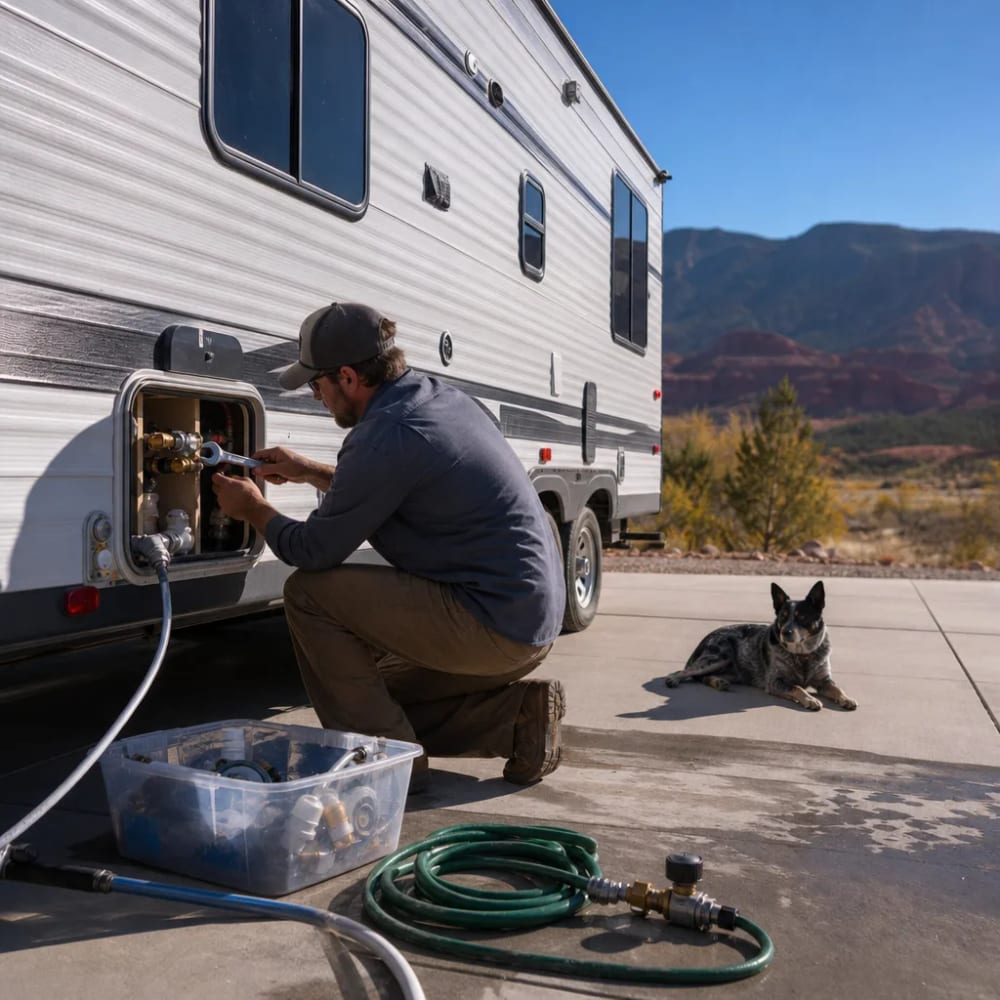
What RV De-Winterization Involves
Most folks picture de-winterization as running the faucets until the pink stuff stops coming out. That's part of it. But your rig has been parked for months, and every system in it has been sitting still the whole time. A good spring start-up treats the plumbing flush as step one, then makes sure everything else wakes up the way it should.
Here's what a thorough spring start-up generally covers:
- Plumbing back in service: flushing RV antifreeze from every line, faucet, shower, and toilet, taking the water heater out of bypass, and closing the low point drains so the system holds pressure.
- Leak check under pressure: a slow drip behind a cabinet or under the water heater access panel often shows up only once the system is pressurized again. Better to find it now than with a soggy floor on night two.
- Water pump and water heater: making sure the pump primes and cycles normally, and that the water heater tank is full before it's ever fired up. Lighting an empty one is a fast way to ruin it.
- Fresh water tank: after a winter of sitting, a lot of owners have the tank sanitized before they drink from it.
- Propane and appliances: checking that the propane system is tight and that the furnace, fridge, stove, and water heater all light and run like they should.
- Batteries and electrical: testing battery health after storage, checking the converter, and confirming that shore power, lights, and fans all work.
- Exterior once-over: roof seals, window and slide seals, tire condition and pressure, and any signs that mice moved in for the winter.
That last one deserves a word. Rodents love a parked RV. It's quiet, it's sheltered, and it's full of wiring they apparently think is a snack. Chewed wires or a nest in the furnace compartment are things you want to find in your driveway, not at a campsite.
Here's what the checklist approach is really about. A cracked fitting or a dead battery won't announce itself while the rig sits in storage. Those problems show up the first time you ask the system to work. So the start-up is your first real chance to test every system, on your schedule, close to home. If something needs more than a quick fix, it's on the table weeks before your trip instead of the morning you pull out.
Some of these pieces are full services on their own. If the start-up turns up a bigger issue, it can roll right into RV plumbing repair, an RV propane system inspection and leak test, RV battery replacement and testing, or RV water heater repair. If you'd like a deeper look at the whole rig before the season, that's what a seasonal RV inspection is for.
In Cedar City, timing matters too. Spring can hand you a warm afternoon and then a freezing night right after it. Putting water back in the lines too early can undo all the work that went into winterizing. Getting the start-up done close to when you'll use the rig keeps your plumbing out of that trap.
Why a Quick Flush Isn't the Same as a Full Start-Up
A flush answers one question: does water come out of the faucets without pink in it? That's a good question. It's just not the one that ruins trips.
Picture this. You run every tap until it's clear, the toilet flushes, and you call it good. Two weeks later you're parked a few hours from home, it's 2 a.m., and it's cold. The furnace clicks, tries, and quits. Or the fridge won't stay lit on propane. Or the battery that seemed fine in the driveway is flat by morning because it never held a charge under real load. None of that had anything to do with water, so the flush never asked about it.
That's the gap. Running the faucets checks for flow. It doesn't tell you whether the system holds pressure overnight, whether the appliances light and stay lit, or whether the battery can carry you through a night off the grid. Your faucet doesn't care if your fridge works.
Even on the plumbing side, a quick flush tends to miss the same few things:
- The water heater still sitting in bypass, so it never fills and never gets flushed.
- A low point drain left open, which you find out about when the pump runs and runs.
- The outdoor shower, the ice maker line, or a washer hookup that never got rinsed, so the first glass of water tastes like a cough drop.
- A slow seep that only shows up after the system has been pressurized for a few hours, not a few minutes.
None of those are hard to fix. They're just easy to skip when the goal is clear water and the job feels done the moment you see it.
Now the honest part. Plenty of owners don't need a full start-up every spring. If you winterized the rig yourself, it's fairly new, it was stored covered, it ran fine right up until you put it away, and your first trip is a short one close to Cedar City, a careful flush may be all it needs. Run the water heater on its own, let the system sit under pressure for a while, light each appliance once, and check the battery. If all of that behaves, you're probably in good shape.
A full start-up earns its keep when the stakes go up. That means an older rig, one stored outdoors all winter, one you bought used last fall and haven't really put through its paces, or a first trip that takes you somewhere a breakdown gets expensive and inconvenient fast. In those cases, you're not paying for someone to open faucets. You're paying to find out what's wrong while you're still close to home, with time to fix it.
Think of it this way. A flush tells you the rig survived the winter. A start-up tells you it's ready for the summer. Those aren't the same promise.
Checking the Propane System Before First Use
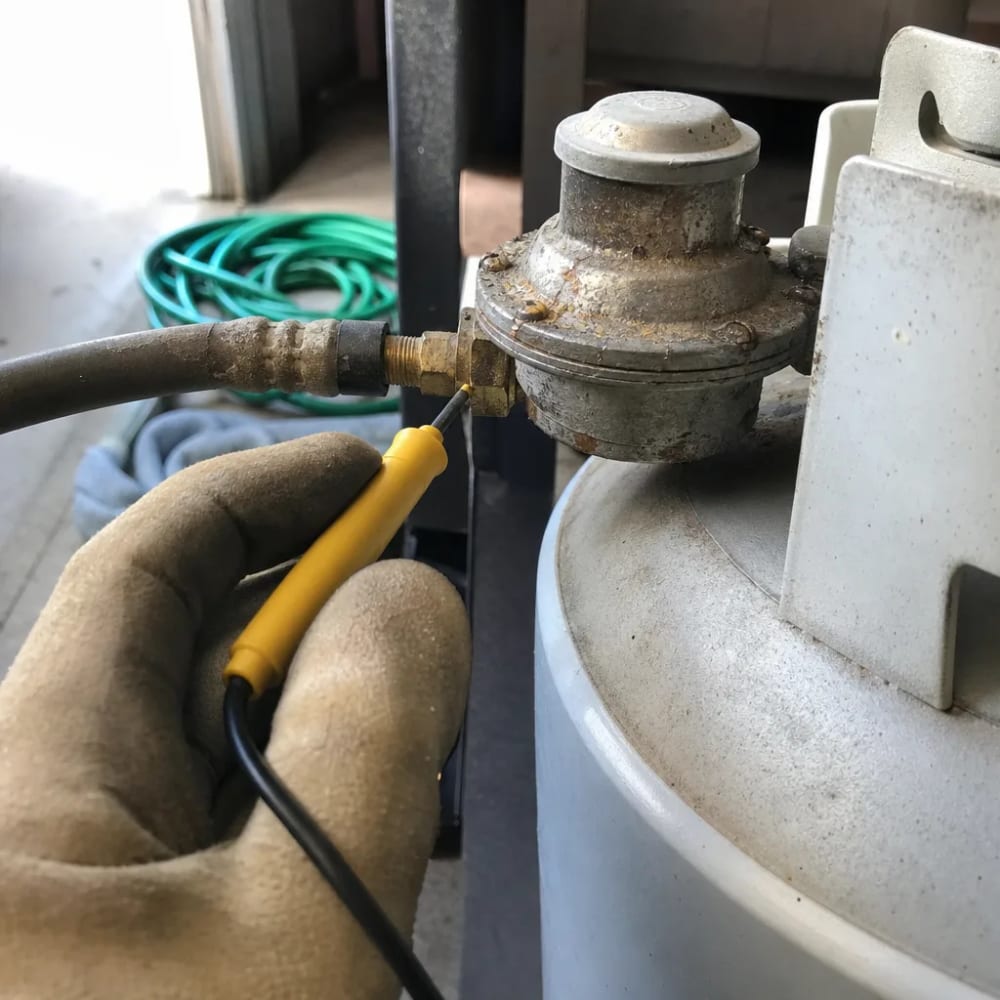
Water problems are messy. Propane problems are the ones you don't want to guess about. Your furnace, water heater, fridge, and stove all run on the same gas system, and that system sat untouched all winter, the same as everything else in the rig. That's why we treat it as its own job during a spring start-up and don't fold it into the general once-over.
The trouble with propane is that "it worked last fall" doesn't tell you much. Fittings can loosen over a season of temperature swings. Rubber hoses dry out and crack. Bugs move in, too. Spiders and wasps seem to think a furnace burner tube or a water heater vent is prime real estate, and a small nest in the wrong spot can keep an appliance from lighting cleanly. You won't see any of that by glancing at the tank.
A proper pre-season propane check generally looks at the whole path the gas travels, from the tank to the burner:
- The tanks or cylinders, valves, and the hoses running off them, checked for cracks, damage, or corrosion.
- The regulator, which controls the pressure feeding everything downstream. A tired regulator can make appliances act flaky in ways that look like an appliance problem.
- The lines and connections, tested for leaks with the system under pressure. Nobody should rely on their nose for this.
- Each appliance lit and run long enough to show it lights reliably, stays lit, and burns with a steady flame.
- Burner tubes and exterior vents, checked for nests, debris, and blockages.
- The LP detector inside the coach, confirmed working and not past the replacement date printed on it.
That detector deserves a quick word. Plenty of owners pull the fuse or disconnect a detector that keeps chirping and then forget about it. If yours has been quiet for a suspiciously long time, it may not be working. It's a small part, and it's the one standing between you and a problem you can't smell while you're asleep.
Here's what you can check yourself without any tools. Look over the hoses at the tank for cracking. Check the date on your LP detector. Peek at the outside vent covers for obvious nests or mud. If you've got a fridge that runs on propane, light it the day before you'd normally load it and see whether it gets cold. If any of that turns up something off, or if you've ever smelled gas around the rig, that's when it's time to have someone look at it, not when you're already at the campsite.
Cedar City spring nights matter here. The furnace isn't a luxury on your first trip of the season, and finding out it won't light is a lot more pleasant in your driveway than at 2 a.m. somewhere cold. If the start-up turns up a bigger issue, it moves on to an RV propane system inspection and leak test, or to RV furnace repair or RV refrigerator repair if one appliance is the holdout.
Signs Your RV Was Not Fully Winterized Last Fall
Here's the thing about freeze damage. It doesn't show up in the fall, and it doesn't show up while the rig sits in storage. It waits for you to turn the pump on in spring. Then it shows up all at once, usually somewhere you can't see.
Cedar City winters get plenty cold enough to freeze water left in a line. If even one spot got missed last fall, water sat in it, froze, expanded, and pushed on whatever was holding it. Plastic fittings and valve bodies don't argue with ice for long.
So before you assume last fall's job was perfect, look for these signs:
- The water pump keeps kicking on with every faucet closed. It's trying to hold pressure, and something is letting it go.
- Water dripping under the rig, or a wet spot on the ground near the water heater, the pump, or the low point drains.
- No pink at all from one faucet when you open it in spring. If antifreeze never made it there, water probably did, and it froze.
- A cracked water filter housing, or a filter that was left in all winter full of water.
- A faucet that sputters, won't shut off all the way, or leaks from the base or handle. Cracked faucet bodies and shower valves are classic freeze damage.
- A toilet that won't hold water in the bowl, or water seeping around the base when you flush.
- A water heater that drips from the drain plug or anode area, or a tank that never seems to fill and hold.
- Soft spots, swelling, or stains on the floor or cabinet bottoms near plumbing runs. That's an old leak that's been at it a while.
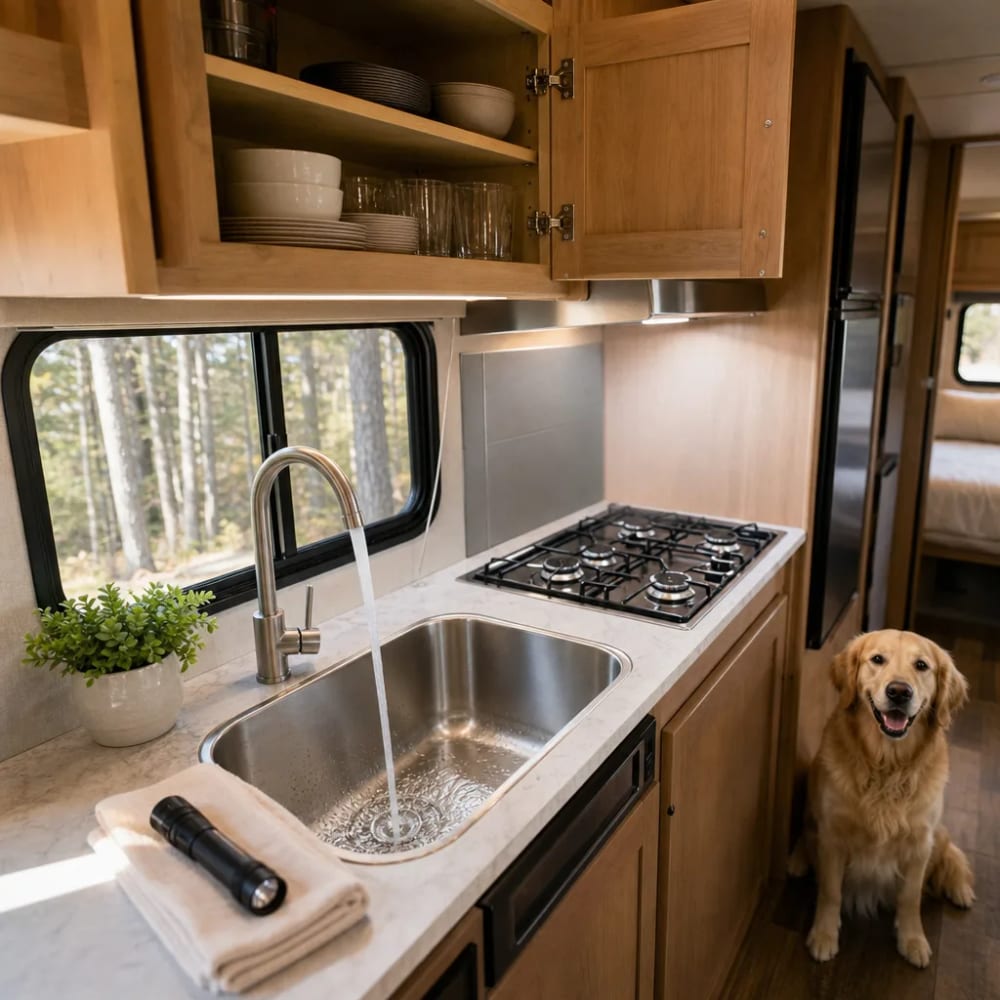
A couple of those take a little patience to catch. A cracked fitting behind a wall might only weep a few drops an hour. So pressurize the system, shut the pump off, and listen. If the pump cycles on by itself later, even once, something is leaking. Then go looking with a flashlight in the cabinets, under the sinks, and behind the water heater access panel.
If you bought the rig used last fall, be a little extra suspicious. You don't know who winterized it, how they did it, or if they did it at all. "The seller said it was winterized" is a sentence that's carried a lot of weight it didn't earn.
Some of these are simple fixes. A cracked filter housing or a leaky drain plug is cheap and quick. Others, like a split line inside a wall or a pump with a cracked head, take more digging. That's where RV plumbing repair, RV water pump repair and replacement, or RV water heater repair comes in.
The good news is that finding freeze damage in your driveway in April is about the best version of finding freeze damage. You've got time, you've got dry ground, and you're not standing in a campsite holding a towel.
When You Can Skip Professional Spring Start-Up
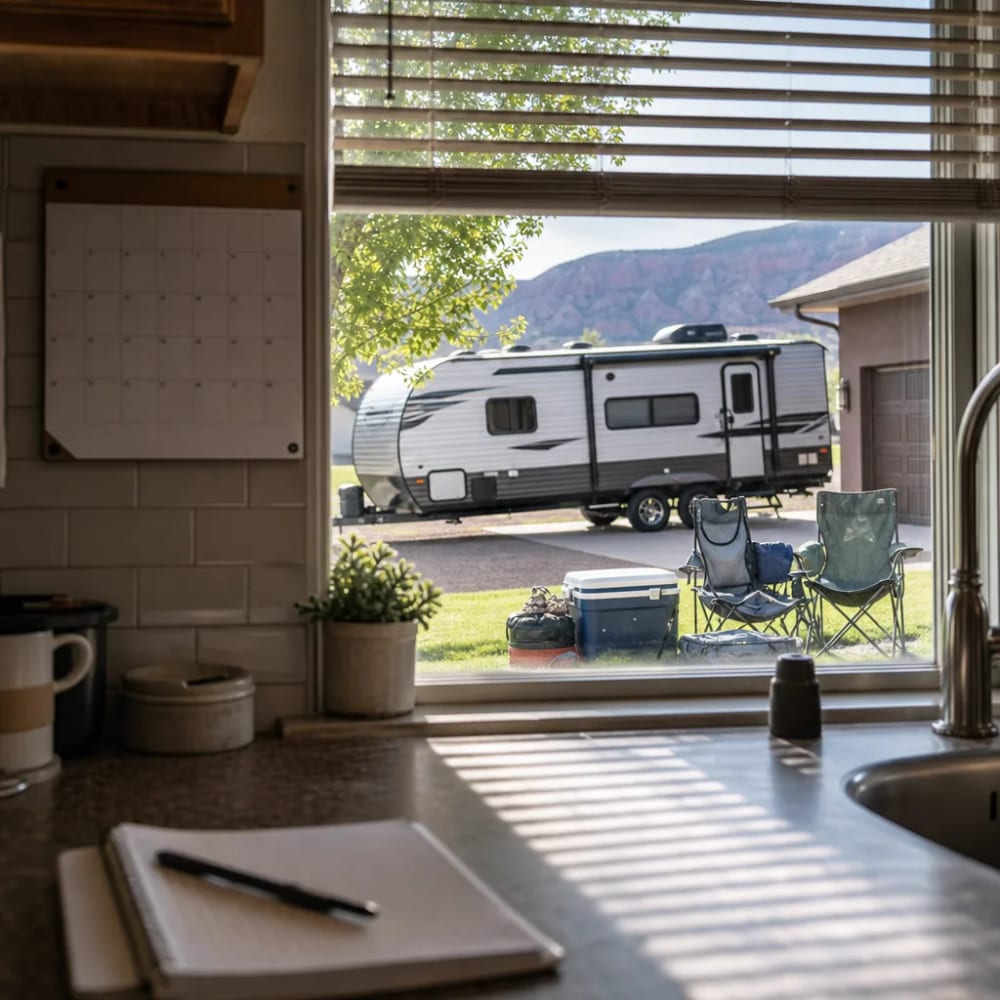
We'll say it plainly. A lot of you can do this yourself, and you'll do it just fine. If your rig fits the low-risk picture from earlier, the real question isn't whether you're allowed to skip us. It's whether you've got what it takes to do the job right instead of halfway.
You're a good fit to handle it yourself if most of these sound like you:
- You've done a spring start-up on this exact rig before, not just a different one. Every coach hides its bypass valve and low point drains somewhere new.
- You know where all the water goes, including the outdoor shower, the ice maker, and any washer hookup.
- You're comfortable lighting each appliance and watching it run, and you'll stop if something seems off.
- You can give it a full afternoon, not twenty minutes before dinner.
- Your first trip is still a few weeks out, so there's time to fix anything you find.
If that's you, here's how to make a DIY start-up count. Pick a mild stretch of days. Fill the system, then leave it under pressure and walk away for a few hours before you call anything good. Then do a shakedown night. Sleep in it in the driveway, or book one night somewhere close to Cedar City. Run the furnace, the fridge, the water heater, and the lights like you would on a real trip. A rig that gets through one honest night at home is a rig you can trust a lot more on night three somewhere else. And if it doesn't, you're a short walk from your own bed.
One more tip that pays off every year. When you winterize in the fall, snap a few photos of the bypass valve and drain positions. Spring you will be grateful. Spring you never remembers which way that valve was supposed to point.
Sometimes the right move is to wait. If your first trip isn't until late May or June, don't rush the water back in just because one April Saturday feels like summer. Cedar City nights can still freeze well into spring, and a line that freezes after you've de-winterized is the same problem as one that froze in January. Leave the antifreeze in until your plans are close. There's no prize for de-winterizing first.
There's also a case where we're simply not the right call. If your rig is brand new and still covered by the manufacturer's warranty, problems that turn up at start-up should probably go back through the dealer that sold it. We don't currently do manufacturer warranty work, so you'll want to check with them before anyone else touches it.
Where DIY stops making sense is pretty clear. If you smell gas, see any of the freeze damage signs covered above, or hit a part of the job you're not sure about, that's your line. Guessing your way through propane or a hidden leak isn't saving money. It's just moving the bill to a worse day.
Frequently Asked Questions
Can I use the city water connection to flush out the antifreeze?
Yes, hooking up to a city water connection works fine for flushing out antifreeze. Just run every faucet, the shower, and the toilet until the water runs clear with no pink tint left. Make sure the water heater is out of bypass first, or it won't get flushed along with the rest of the lines.
What water pressure should my RV system run at once it's back in service?
Most RV water systems are built to handle around 40 to 50 psi, and anything higher can stress fittings and valves. A pressure regulator between the hose and your rig keeps you in that safe range. Older rigs or ones with freeze damage from last winter are especially prone to leaks if the pressure runs too high.