
RV Door and Entry Step Repair · Cedar City, Utah
RV Door and Entry Step Repair in Cedar City, Utah: Hardware Fix or Replacement?
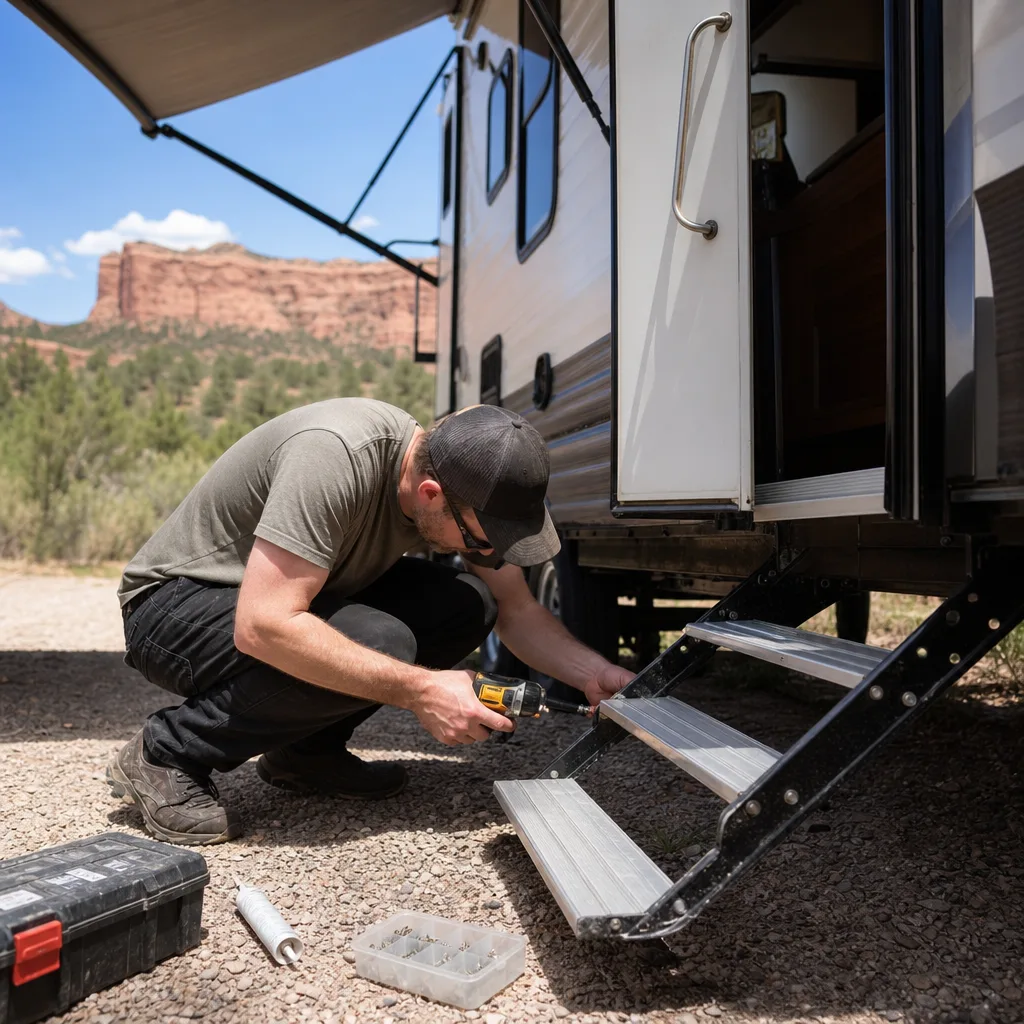
Diagnosing a Door That Won't Latch or a Step That Won't Move
Before anybody orders parts, we want to know why the door or step quit. Swapping a latch on a door that's sagging just gives you a nice new latch that still doesn't catch. Here's how to narrow it down yourself in about ten minutes.
If your door won't latch, start with the rig. Level it first. An RV body flexes a little when one corner sits low, and that's enough to pull the door frame out of square. If the door suddenly latches once you're level, you've found your problem, and it didn't cost you a dime.
- Work the latch with the door open. Turn the handle and watch the bolt. If it sticks, drags, or doesn't spring back, the latch itself is worn or dirty.
- Look at the strike plate on the frame. Shiny scrape marks above or below the opening mean the door and strike don't line up anymore.
- Grab the open door by the handle edge and lift gently. If it moves up and down, check the hinge screws. Loose screws let the door drop.
- Check the weatherstrip. Seals that have swollen, torn, or bunched up can push the door back just enough to keep it from catching.
- Try the deadbolt by itself. If it binds, the door is out of line even if the main latch seems fine.
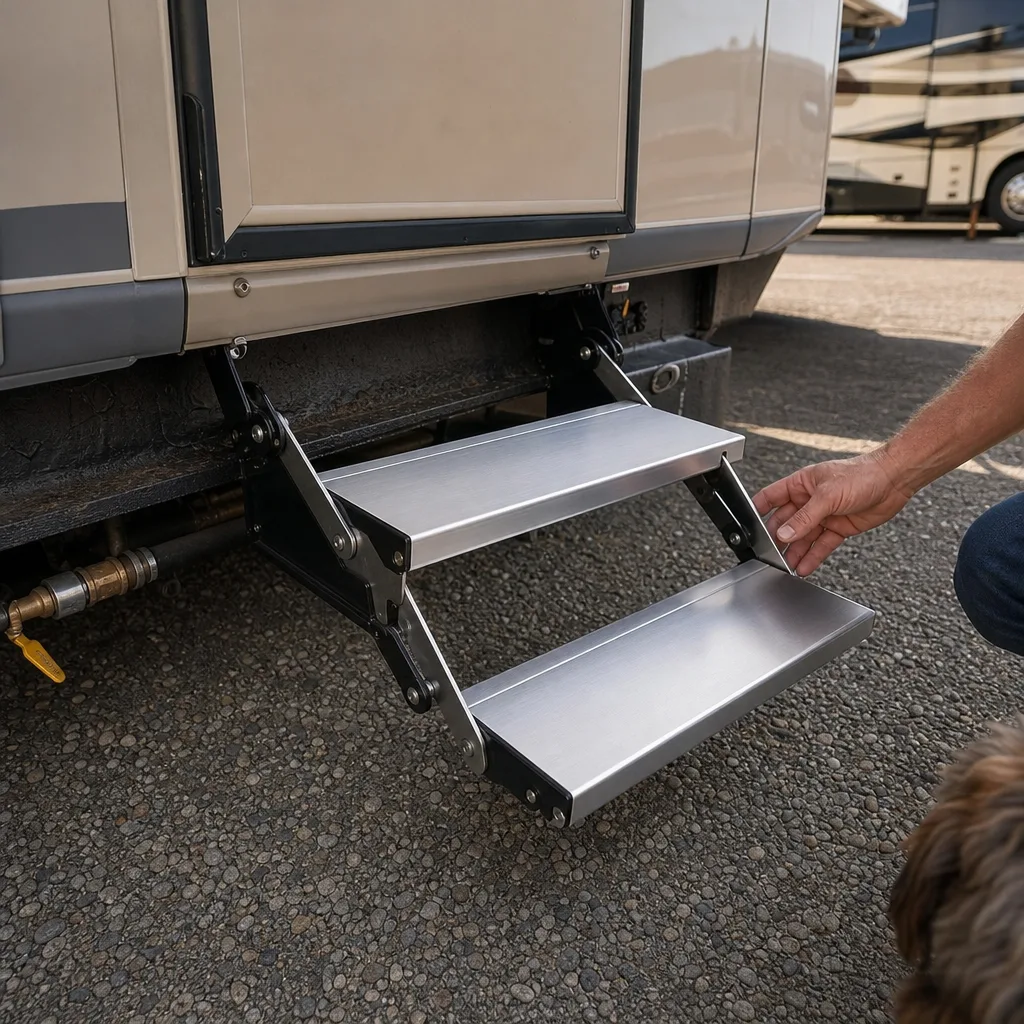
If your step won't move, ask whether it's an electric step or a manual one. For electric steps, go after power before you blame the motor. Many rigs have a step switch near the door that turns the motor off, and it gets bumped by elbows, kids, and grocery bags more often than you'd think. Then check the fuse and your battery. A low battery can leave the step groaning halfway out like it's trying to get out of bed on a Monday.
- Listen when you open and close the door. A click or hum with no movement points to the linkage or motor. Total silence points to power, a fuse, or a switch.
- Look under the step for packed dirt, rocks, or rust around the pivot points. Grit in the linkage can stop a healthy motor cold.
- For manual steps, check for dry or rusted pivot pins and bent arms. A step that's been backed into a curb rarely folds the same again.
- Watch for a step that drifts, wobbles, or won't lock in place. That one's a safety problem, not a nuisance.
One rule we don't bend: if a step shifts under your weight or won't lock out, stop using it until it's fixed. A door you have to slam twice is annoying. A step that folds while you're carrying a cooler is a trip to urgent care.
If you've done these checks and you can point to the cause, that's great. If you can't, write down what you saw and heard. That tells a technician a lot and keeps the repair focused on what's wrong.
Hardware Repair Versus Step or Door Replacement
Most of the time, you don't need a new door or a new step. You need the one worn or knocked-loose part that's making the whole thing act up. A door is a frame, a skin, hinges, a latch, a strike, and a seal. A step is a frame, some arms and pins, and on electric models a motor, a switch, and some wiring. When one of those fails, we fix that piece and leave the good parts alone.
That's why we want the cause nailed down before anyone talks about replacing anything. Replacing a whole step because a pivot pin is rusted is like buying a new truck because the wiper blades squeak.
These usually end with a repair:
- A latch that sticks, won't spring back, or has a cracked handle
- A strike plate that needs to be reset so it lines up with the latch again
- Hinge screws that pulled loose and need new bite in the frame
- Weatherstrip that's torn, flattened, or swollen
- A step switch, fuse, or wire connection that quit
- Dry or rusted pivot pins and linkage that need cleaning, new pins, or new bushings
- A step motor that's truly worn out, when the frame and arms are still straight and solid
Replacement makes sense when the main structure is damaged, not just the hardware hanging on it. Here's where we'd tell you to stop putting money into the old one:
- A step frame that's bent, twisted, or cracked at a weld. You can sometimes straighten a bent arm, but a step that's been tweaked rarely locks out solid again, and that's the one job a step can't fail at.
- Step mounting points that are rusted thin or torn out of the frame
- A door that's been folded back by the wind. One strong gust can catch an open door, slam it past its stop, and bend the hinge side. Sometimes it's only the hinge. Sometimes the door itself is warped and won't ever seal right again.
- A door with a soft, delaminated, or water-damaged core, where the skin bubbles or the frame feels spongy around the latch or hinges
If it's close, we'll tell you what we see and let you make the call. A step that you'll use every day for the next ten years is a different decision than a step on a trailer you're selling next spring.
On cost, the pricing in this trade mostly comes down to two things: labor time and parts. A latch swap or strike adjustment is quick. Chasing a wiring problem or freeing up a seized linkage takes longer. Parts cost depends on your rig. Common latches and steps are easy to find. Older or odd-size doors and steps can take longer to track down and cost more, and a full door almost always means waiting on a part sized to your rig's opening. Before you hire anyone, ask whether they're quoting a repair or a replacement, and why. If they can't point to the cause, they're guessing with your money.
Signs the Problem Can Wait and Signs It Can't
Not every door or step problem means you need to cancel your weekend. Some can sit until the season's over. A few shouldn't sit one more mile. The difference comes down to three questions. Can the door lock and stay shut? Can the step lock out and tuck away? Is water getting in?
These can usually wait, and some you can handle yourself:
- A door that needs a firm push to latch but latches every time, locks, and seals. It's annoying, not dangerous. Level the rig first, since that alone fixes plenty of these.
- A step that squeaks, creaks, or sounds a little grumpy. Clean out the dirt and gravel, then lube the pivot points. Lots of noisy steps just need a bath.
- An electric step that runs a little slow on a cold morning but goes all the way out, all the way in, and locks solid. Check your battery before you worry about the motor.
- A handle that feels loose but still works the latch. Snug the screws and keep an eye on it.
- Weatherstrip that looks tired but still seals. Plan to replace it before it starts letting water and dust in.
If one of these is bugging you on a rig that sits in storage most of the year, there's no shame in fixing it on your own time. Waiting a few weeks won't turn a squeaky step into a broken one.
These can't wait:
- A door that won't stay latched while you're driving. A door that pops open at highway speed is the fastest way to end up with the wind-folded door we covered above, and anything near the doorway can go with it.
- A deadbolt or main lock that won't lock. If you're parked at a campground or leaving the rig at a storage lot, an RV you can't lock is an open invitation.
- An electric step that won't retract. Driving off with the step hanging out is how steps meet curbs, gas pump islands, and parking posts. The step usually loses.
- A step that wobbles, drifts, or won't lock out. As we said earlier, stop using it until it's fixed.
- A torn seal or a gap you can see daylight through. Water that gets past the door works its way into the frame and the floor. A small seal problem left alone can turn into the soft, spongy door core problem, and that's a much bigger bill.
Here's one more way to think about it. If the problem bugs you, it can usually wait. If it could hurt somebody, let the weather in, or leave your stuff unlocked, deal with it now.
There's also a middle ground. Say you're two days into a trip and the step won't come in. Don't drive off hoping it'll hold. Getting it fixed where you're parked beats limping home and finding out at the first fuel stop that it didn't hold. We do On-Site Campground RV Repair and RV Repair at Home or Storage Lot, so the rig doesn't have to move until it's safe to move.
If you've gone through the checks and you're still not sure which list you're on, tell us what you saw and heard. We'll tell you straight whether it needs us today or whether you can finish your trip first.
Call nowWhat Happens During a Mobile Door or Step Repair Visit
Booking with us is pretty simple. When you call, you'll talk to me or to my wife. She runs the office, sets the appointments, and keeps the calendar from turning into a game of Tetris. I'm the lead technician and your main point of contact, so the person you describe the problem to is the same person who shows up to fix it. Nothing gets lost in a hand-off.
On that first call, tell us what you found when you ran the checks above. Things like "it latches when I'm level" or "the step clicks but won't move" help a lot. Tell us the year, make, and model too. If you can snap a photo of the latch, the strike, or the underside of the step, even better. That helps us show up with the right idea of what we're dealing with, not just a hunch.
We're a mobile service, so we come to the rig. Your driveway, your storage lot, or your campsite all work. A few things you can do before we get there will make the visit quicker and easier on your wallet:
- Park so the door can swing all the way open. A door jammed against a fence post or the RV in the next slot is hard to work on.
- Level the rig if you can. We'll want to see how the door acts when the body is square.
- Clear the doorway and the area under the step. Shoes, rugs, and the dog's water bowl all tend to camp right there.
- For an electric step, keep the battery charged or plug into shore power. It's hard to test a motor that has nothing to run on.
- Have your keys handy, including the deadbolt key. People often forget that one until it's needed.
Once we're there, the job follows the same rule as the rest of this page. Find the cause first, then fix that part. If the fix needs a part that's not on hand, especially for an older or odd-size door or step, we'll tell you what it is and why before anything gets ordered.
Before the job is done, test it yourself. Don't just take our word for it. You're the one who'll be using that door and step every day, so here's what to check:
- Open and close the door five or six times. It should latch every time without a slam.
- Lock and unlock both the main latch and the deadbolt from the outside.
- Close the door during the day and look for daylight around the seal from inside.
- Run an electric step all the way out and all the way in a few times, then stand on it. It should feel solid, with no drift or wobble.
- Fold a manual step in and out and make sure it locks in both spots.
If something still feels off, say so while we're standing right there. It's a lot easier to fix it on the spot than after you've packed up and hit the road. When the job's done, the office sends your invoice.
You're getting an RVTI Certified Technician with more than 15 years in the RV business. I started out washing trailers on a dealer lot and worked my way up from there. I've opened and closed more RV doors than I can count, and I still test every one like it's the first.
Call nowConfirming the Repair Before the Technician Leaves
A door that latches while the tech is standing there is a good start. But you also want to know why it quit and whether that reason is gone for good. Before we pack up, you should be able to answer three questions in your own words.
- What was the cause? Not just "the latch," but why the latch failed. Was it worn out, out of line, or fighting a door that sagged?
- What got replaced, and what got adjusted? A new part and a reset part are different things, and you'll want to know which is which down the road.
- Can it come back? If the cause was a loose hinge or a rig parked off level, there are things you can do to keep it from happening again.
If the answer to any of those is a shrug, ask again. You're not being a pain. You're making sure you paid for a fix and not a lucky guess.
Next, test the parts people forget. Most folks check the main door and the step, and that's it. Then they get to camp and find out the screen door won't catch anymore. A screen door that sits inside the main door depends on the same alignment, so if the main door got shifted even a little, run the screen door and its slide panel too. Lock the door from the inside, not just the outside. If your electric step is set up to pull in on its own when the door shuts or the engine starts, try that while we're there. Don't wait until you're backing out of your driveway to find out.
Your first trip is the real test. A door that's perfect in the driveway still has to ride through a few hundred miles of bumps and potholes. After that first drive, take two minutes and do this:
- Snug the hinge screws and the handle screws. A freshly reset screw can settle a little once the door has been bounced around.
- Level the rig, then open and close the door a few times. If it latches level but fights you when you're parked off level, you know the rig is the issue, not the repair.
- Look at new weatherstrip. Fresh seals can feel snug at first and ease up as they settle. A door that's a touch stiff on day one is normal. A door you have to slam on day ten isn't.
- Peek under the step. If it picked up a load of mud or gravel on the way, clean it out before it packs into the linkage again.
If something has changed since the repair, write down what you noticed, the same way you did when it first quit. Something like "it latched fine until we hit the washboard road" tells us a lot more than "it's acting up again."
Keeping it fixed doesn't take much. Level the rig when you park, keep the step clean, and give the pivot points a little lube now and then. A door and step that get a few minutes of attention each season will outlast the folks who only notice them when they quit, and that's the whole point. Find the real cause, fix that part, and make sure it stays fixed.
Call Benny's RVFrequently Asked Questions
Can you fix an RV door or step while I'm still parked at a campground, or do I need to bring it to a shop?
Yes, we come to you wherever you're parked, including a campground, your home, or a storage lot. If a step won't retract or a door won't lock mid-trip, you don't need to drive anywhere to get it looked at. We'd rather get it fixed on-site than have you risk driving with a step that could hit a curb or a door that could pop open.
My RV door only sticks when I'm parked off level. Is that a problem with the door?
Usually not. The door itself is probably fine, and the issue is the rig flexing out of square when one corner sits low. Leveling the rig first is the quickest free fix, and if the door latches fine once you're level, you've found your answer without spending a dime.
What should I write down before I call about a door or step problem?
Jot down exactly what you saw or heard, like whether the step clicked but didn't move, or the door only latches when the rig is level. Include your rig's year, make, and model too. A photo of the latch, strike plate, or underside of the step helps us show up already knowing what we're likely dealing with.