
RV Electrical Troubleshooting · Cedar City, Utah
RV Electrical Troubleshooting in Cedar City, Utah: Finding the Real Cause
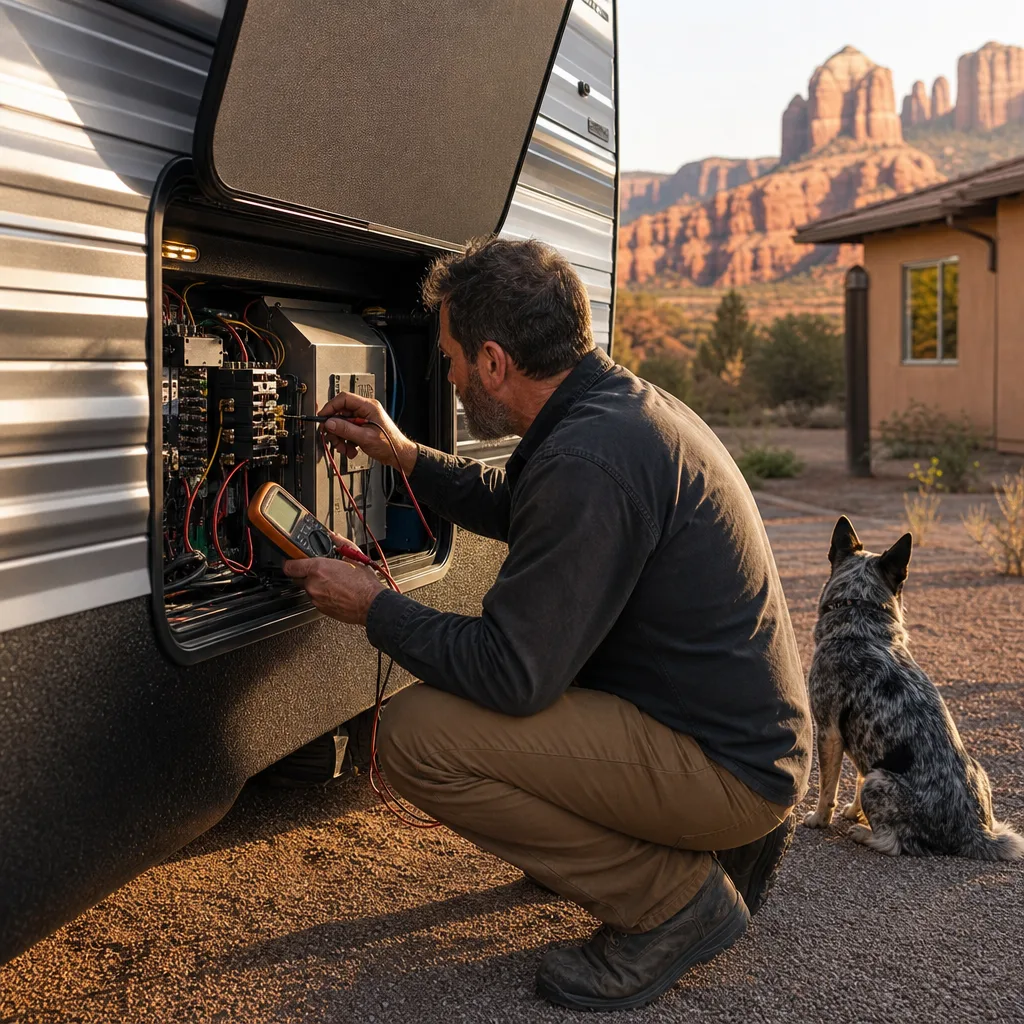
Deciding Between a Quick Fix and a Full Diagnosis
Not every dead outlet needs a technician. Plenty of RV power problems come down to one small thing that got bumped, tripped, or left off. Before you call anybody, including us, run through these checks. They're free, and they take about ten minutes.
- Check the GFCI outlets. One tripped GFCI can kill power to several outlets, including ones outside or in the bathroom. Find it and press reset.
- Look at the main breaker panel inside the rig and the breaker on the campground pedestal. Flip any tripped breaker fully off, then back on.
- Check your battery disconnect switch. It's easy to leave it off after storage, and then nothing on the 12-volt side works.
- Look over the 12-volt fuse panel for a blown fuse. If you replace one, use the same amp rating. A bigger fuse doesn't fix anything. It just lets the wire get hot.
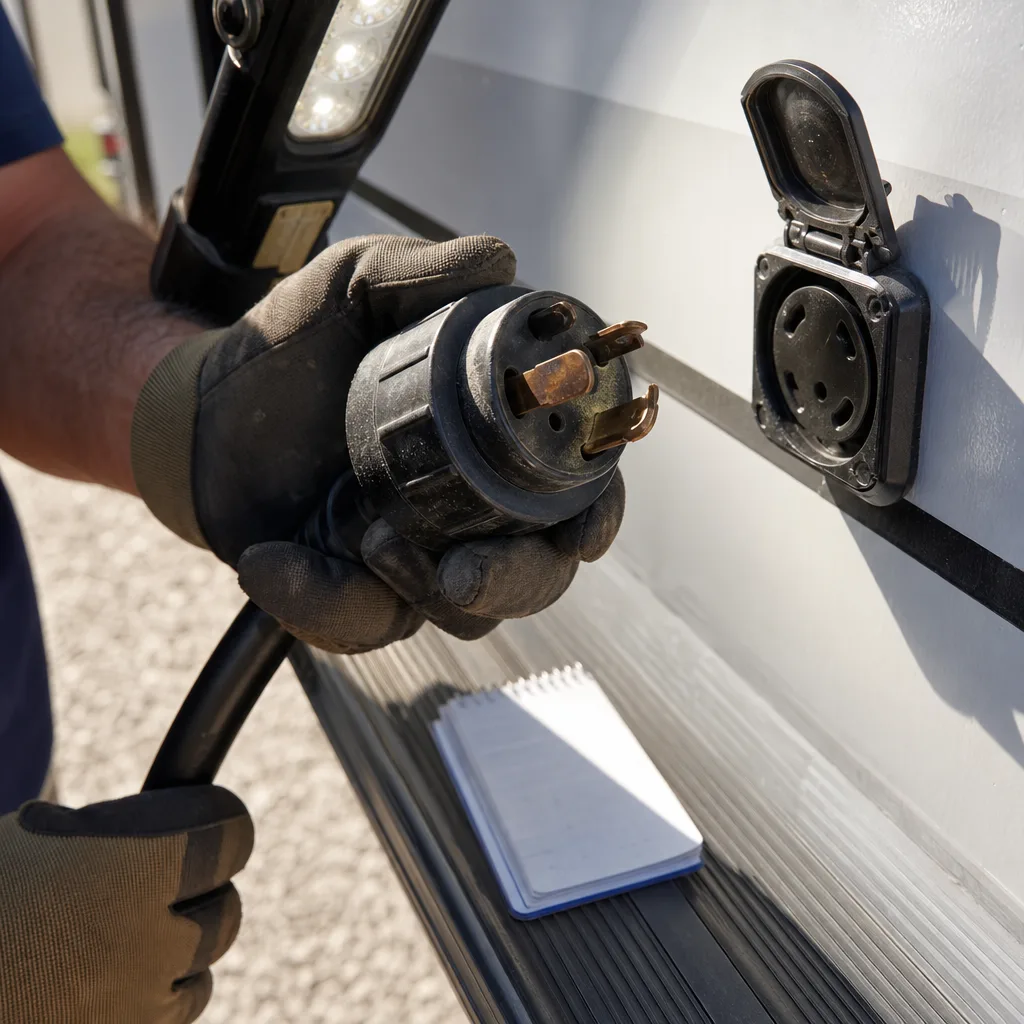
- Unplug the shore power cord and look at the plug ends. Burn marks, melted plastic, or loose prongs mean you should stop right there.
If one of those checks fixes it and the problem doesn't come back, you're done. Go enjoy your trip. The trouble starts when the fix doesn't hold.
Here's a common one. You run the air conditioner and the microwave at the same time, and the breaker trips. You reset it, and it trips again an hour later. You can keep flipping it, but the breaker is doing its job. It's telling you something is drawing too much power, a connection is loose, or the breaker itself is worn out. Resetting it over and over is like hitting snooze on a smoke alarm.
These signs mean it's time for a full diagnosis, not another reset:
- The same breaker or fuse keeps tripping or blowing.
- The problem comes and goes, especially when you hit bumps or the weather changes.
- Your lights dim or flicker when an appliance kicks on.
- The shore cord, plug, or outlet feels warm, or you smell something hot or burnt.
- More than one system acts up at once, like the fridge and the furnace both quitting.
- Things went wrong right after you plugged into a bad pedestal or rode out a power surge.
A burning smell or a hot plug isn't a "wait and see" problem. Unplug from shore power and don't use that circuit until someone has looked at it.
Diagnosis costs usually come down to time. A fault that shows up right away is faster to track down than one that only appears on a 90-degree afternoon with the AC running. Most shops and mobile techs bill diagnostic work one of two ways: a flat diagnostic fee or hourly labor. Mobile service may add a trip charge. Before you hire anyone, ask how they bill the diagnosis, whether that time counts toward the repair, and whether they'll explain what they found before they fix anything.
We're an RVTI Certified Technician team with more than 15 years of hands-on experience in the RV world, and we come to you. Tracing a fault back to where it starts is the part of the job worth paying for. Parts are easy. Knowing which part is the hard bit.
Call nowWhy One Dead Outlet Rarely Means a Bad Outlet
Here's something that surprises a lot of RV owners. The outlet that quit working is usually just the messenger. In most RVs, outlets are wired in a chain. Power comes into the first one, then feeds the next, and the next, down the line. If a connection fails at outlet number two, outlets three, four, and five go dark too, even though nothing is wrong with them.
So you pull the dead outlet, buy a shiny new one, wire it in, and flip the breaker. Still dead. Now you're out a few bucks, a chunk of your Saturday, and a little bit of pride. The outlet was never the problem. It was just standing at the end of the line where the bad news showed up.
It gets trickier because your RV really runs on two electrical systems. The 120-volt side runs off shore power, a generator, or an inverter, and it feeds your wall outlets, air conditioner, and microwave. The 12-volt side runs off your batteries and handles the lights, water pump, vent fans, furnace blower, and the control boards on a lot of appliances. The converter ties them together by turning shore power into 12 volts and charging your batteries.
That's why problems show up in strange places. Say your lights work fine while you're plugged in, then fade out an hour after you unplug. The lights are fine. The trouble is in the battery, the charging, or the converter. Or the furnace won't light, but the real issue is low 12-volt power that can't run the blower or the control board. The symptom lives in one spot and the cause lives somewhere else.
When one outlet or one circuit goes dead, these are the usual suspects hiding upstream:
- A loose connection at an earlier outlet in the chain. Many RV outlets use quick-connect terminals instead of screw terminals, and road vibration can work them loose over time.
- A worn breaker that looks fine but doesn't pass power the way it should.
- A loose neutral wire. This one can make some outlets go dead while others act weird, like dim lights or appliances that run poorly.
- The transfer switch, which picks between shore power and the generator. If it sticks or a contact wears out, power may never reach the panel.
- A tired converter that leaves the 12-volt side starving even while you're plugged in.
There's one more thing worth knowing. RV walls are thin, and RV outlets are built to clamp into them. A standard household outlet doesn't always fit or hold the same way, so a hardware store swap can create a brand new loose connection in the process. Fixing one problem by making another is a lousy trade.
This is the whole reason troubleshooting matters. A good diagnosis starts at the power source and works forward, testing each point until the power stops where it shouldn't. That's how you find the one bad connection instead of replacing five good parts around it. Throwing parts at an electrical problem is like changing every tire on the truck because one of them has a nail in it.
If the trail leads to a specific piece, it often turns into a focused repair. A bad converter falls under our RV converter and inverter repair, and a problem at the cord or inlet points to shore power and 30/50 amp repair. Either way, you're fixing the thing that broke.
Signs That Call for Immediate Attention
Most electrical gremlins are annoying, not dangerous. You can live with a dead outlet for a weekend. A few signs are different, though. They mean electricity is going somewhere it shouldn't, and waiting only gives it more time to cause trouble. We already covered the hot plug and the burning smell. Here are the others that belong on the same "stop right now" list.
First and most serious, you feel a tingle or a little zap when you touch the door handle, the entry step, or the metal skin of the rig. That isn't static, and it isn't your imagination. It usually means the RV's frame or body has power on it, often from a ground problem at the pedestal, the cord, or inside the rig. Don't keep touching it to "double-check," and keep kids and pets away from the steps. If you can reach the campground pedestal without touching the RV, switch that breaker off.
- Smoke, crackling, popping, or buzzing from the breaker panel, an outlet, or behind a wall. A healthy electrical system is quiet.
- Scorch marks, brown stains, or melted plastic on an outlet cover, switch, or the panel itself.
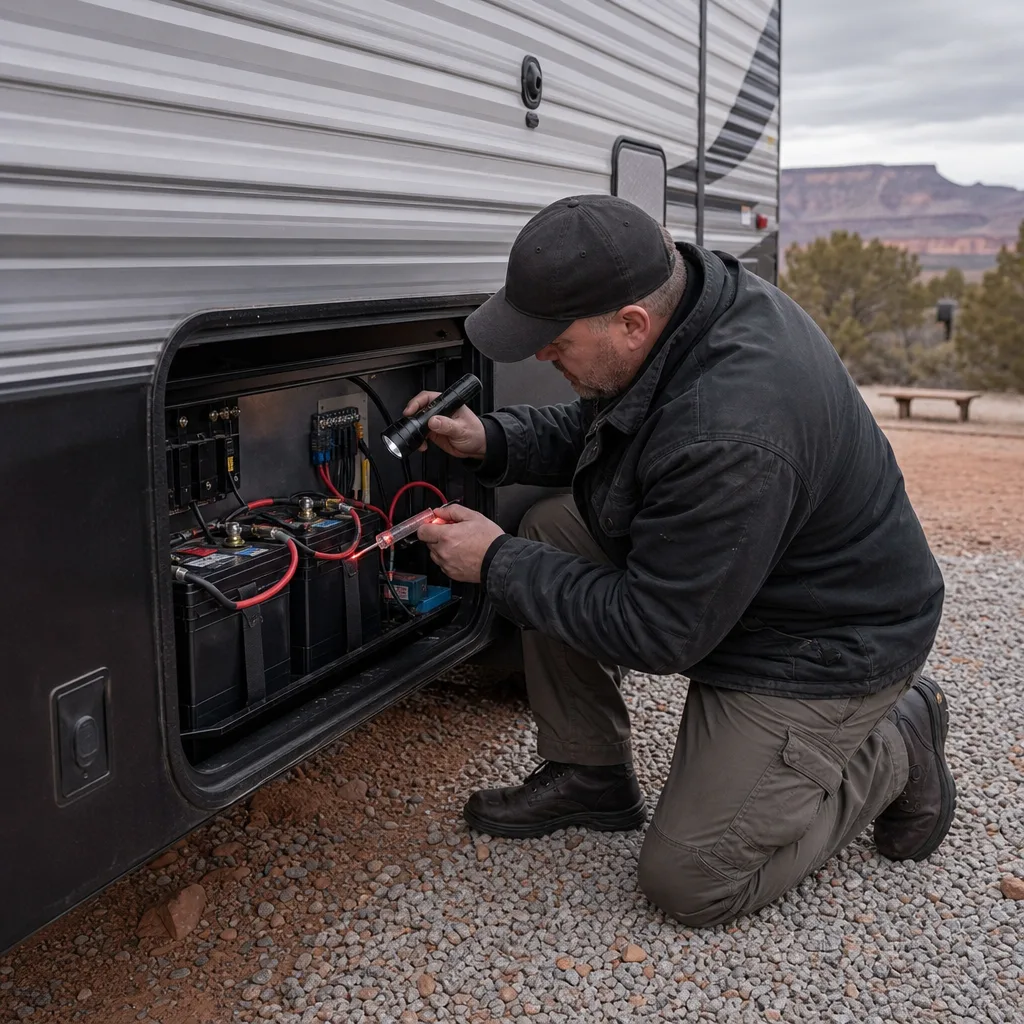
- A rotten egg smell near the batteries, a battery case that looks puffy or swollen, or batteries that are hot to the touch. That points to overcharging, and it's not something to sleep next to.
- Water where it shouldn't be near wiring, like a roof leak dripping onto a light fixture or a wet spot around an outlet or the panel.
- Lights that suddenly get brighter, or several appliances and control boards quitting all at once. Big voltage swings can cook electronics fast.
Here's the trap we want you to avoid. Something smells funny, you flip a breaker, the smell fades, and everything seems fine. So you flip it back on to see if it was a fluke. Please don't run that experiment. A wire that got hot once got hot for a reason, and the insulation is weaker now than it was before. The second time is usually worse than the first. Curiosity is great for a lot of things. Live wiring isn't one of them.
If you're seeing any of these, cut the power you safely can, stop using the affected circuit, and leave the wiring alone until someone tests it. That includes not swapping parts "just to see." With these signs, the goal isn't to get the lights back on tonight. It's to make sure the rig is safe to be in.
Not sure if what you're seeing counts? Describe it to us. A quick conversation is usually enough to tell whether it can wait for a regular appointment or needs attention now. We offer emergency mobile RV repair, and we come to you, so you don't have to tow a rig with a wiring problem down the road.
Call nowWhen the Problem Shows Up Only Off Shore Power
This one catches a lot of folks on their first night of dry camping. Everything worked in the driveway. You get out where there's no pedestal, the sun goes down, and the rig starts acting like it's had a long day too. Around 3 a.m. the furnace blower sounds tired, and then the propane detector starts chirping about low voltage. Nothing's broken in the furnace. It's starving.
When a problem only shows up off shore power, the good news is it narrows the search fast. Shore power can hide a weak battery because the converter keeps feeding the 12-volt side the whole time. Unplug, and you find out what your batteries can really do on their own. So the first question we ask is simple: which power source were you on when it went wrong?
- On batteries only: lights dim, the water pump slows, or slide and leveling motors struggle. That points to a battery that won't hold a charge, a weak connection at the battery terminals or disconnect, or something draining the batteries in the background.
- On the generator: the 12-volt stuff might be fine, but the wall outlets and AC are dead or flaky. That points to the generator's own breaker, its output, or the transfer switch we talked about earlier not switching over cleanly.
- On the inverter: some outlets work and some don't. Many RVs only wire a few outlets to the inverter, so a dead outlet may just be one that was never on it. If none of them work, the inverter or its wiring is the next stop.
Batteries are the usual weak spot, and they're sneaky about it. A tired battery can show a decent reading on a meter while it's resting, then fall flat the second the furnace or the pump asks it for real work. That's why we load test instead of just checking voltage. A resting reading tells you the battery's mood. A load test tells you if it can do the job.
Then there's the slow leak nobody thinks about. Your propane and CO detectors, the stereo memory, and the control boards on the fridge and water heater all sip power around the clock, even when everything looks off. On shore power, you never notice. In storage or out camping, those little sips can flatten a battery in days. If your batteries are dead every time you pull the rig out of the lot, the battery disconnect may not be cutting everything, or something's drawing more than it should.
Here's the mistake to skip. A lot of people buy new batteries first, and sometimes that's the right call. But if the real issue is a converter that never fully charges them or a hidden drain, the new ones die the same way, just with a nicer label on them. We check the charging side and the draw before anybody spends money on batteries.
If the batteries do turn out to be the problem, that's handled under our RV battery replacement and testing service. If it's the inverter or the charger, it moves over to converter and inverter repair. Either way, you'll know what failed before you replace anything, and your next night off the grid can be a quiet one.
Cold Weather and Battery-Related Symptoms
Cold doesn't break your electrical system. It calls its bluff. A battery that limps along fine in July can fold on a frosty Cedar City morning, because cold slows down the chemistry inside the battery and it can't hand over as much power. At the same time, you're asking more of it. The furnace blower runs longer, tank heaters may be pulling 12 volts, and slide motors push against stiff seals and thick grease. Weaker supply, bigger demand. Something gives.
So the first question in winter is whether the cold caused the problem or just exposed one that was already there. A healthy battery in good shape gets a little sluggish in the cold. A tired one quits.
These cold-weather symptoms are worth taking seriously:
- The furnace runs fine in the evening but won't keep going overnight, or it clicks and tries without lighting by morning. That's often low 12-volt power, not a bad furnace.
- Slides or leveling jacks move slowly, stall halfway, or only work after the rig warms up.
- Batteries come out of winter storage completely dead, even though they were charged when you parked.
- A battery case looks bulged, cracked, or wet after a hard freeze.
- Lithium batteries that show plenty of charge but refuse to take a charge on a cold morning.
That last one confuses a lot of people. Many lithium batteries have built-in protection that blocks charging when they're below freezing. You plug in or fire up the generator, and nothing happens. It's not broken. It's protecting itself. Once the battery warms up, charging usually comes back on its own. If it doesn't, that's when we dig in.
Lead-acid batteries have the opposite weak spot. A fully charged one handles cold pretty well. A run-down one can freeze, and a frozen battery with a swollen or cracked case is finished. That's where the dead-in-storage problem bites. A small drain pulls the battery down over a few weeks, a cold snap hits a half-empty battery, and spring starts with a shopping trip. We covered how those hidden drains work earlier. Winter is just when they do the most damage.
Cold also brings condensation. Moisture settles on battery terminals and connections, and corrosion builds up. That white or greenish crust adds resistance, so even a good battery can look weak because power can't get through the connection cleanly. If your rig acts worse every winter and better every summer, loose or corroded connections belong near the top of the suspect list.
A few habits go a long way. Keep lead-acid batteries charged through the winter, or pull them and store them somewhere that stays above freezing. Make sure the disconnect cuts power when the rig is parked. Clean and tighten the terminals before you put the rig away, not after it won't start.
If you're putting the rig up for the season, our RV winterization service is a good time to have the battery side looked at too. And if you'd rather not think about it every fall and spring, that's what our RV seasonal inspection membership is for.
Call nowFrequently Asked Questions
Do you come to my RV, or do I have to bring it somewhere in Cedar City?
We come to you, wherever your RV is parked in Cedar City. That means no towing a rig with a wiring problem down the road, which matters most when the issue is electrical and you don't want to risk driving it.
Can I just swap a dead outlet myself instead of calling for troubleshooting?
You can try, but it usually won't fix the problem. RV outlets are wired in a chain, so a dead outlet is often just the messenger for a loose connection somewhere earlier in the line. Swapping the outlet itself leaves the real fault untouched, and a standard hardware store outlet may not even clamp into thin RV walls correctly.
Why does my RV work fine on shore power but have problems when I'm dry camping?
Shore power hides a weak battery because the converter keeps feeding the 12-volt side the whole time you're plugged in. Once you unplug, you find out what your batteries can do on their own, which is why furnace or pump problems often show up for the first time overnight while dry camping.
Is it normal for my RV batteries to struggle more in cold weather?
Yes, cold slows the chemistry inside a battery so it can't deliver as much power, right when the furnace and slide motors are asking for more. A healthy battery just gets sluggish in the cold, but a tired one will quit, so repeated cold-weather failures usually point to a battery or connection that was already weak.