
RV Propane System Inspection and Leak Test · Cedar City, Utah
RV Propane System Inspection and Leak Test in Cedar City, Utah
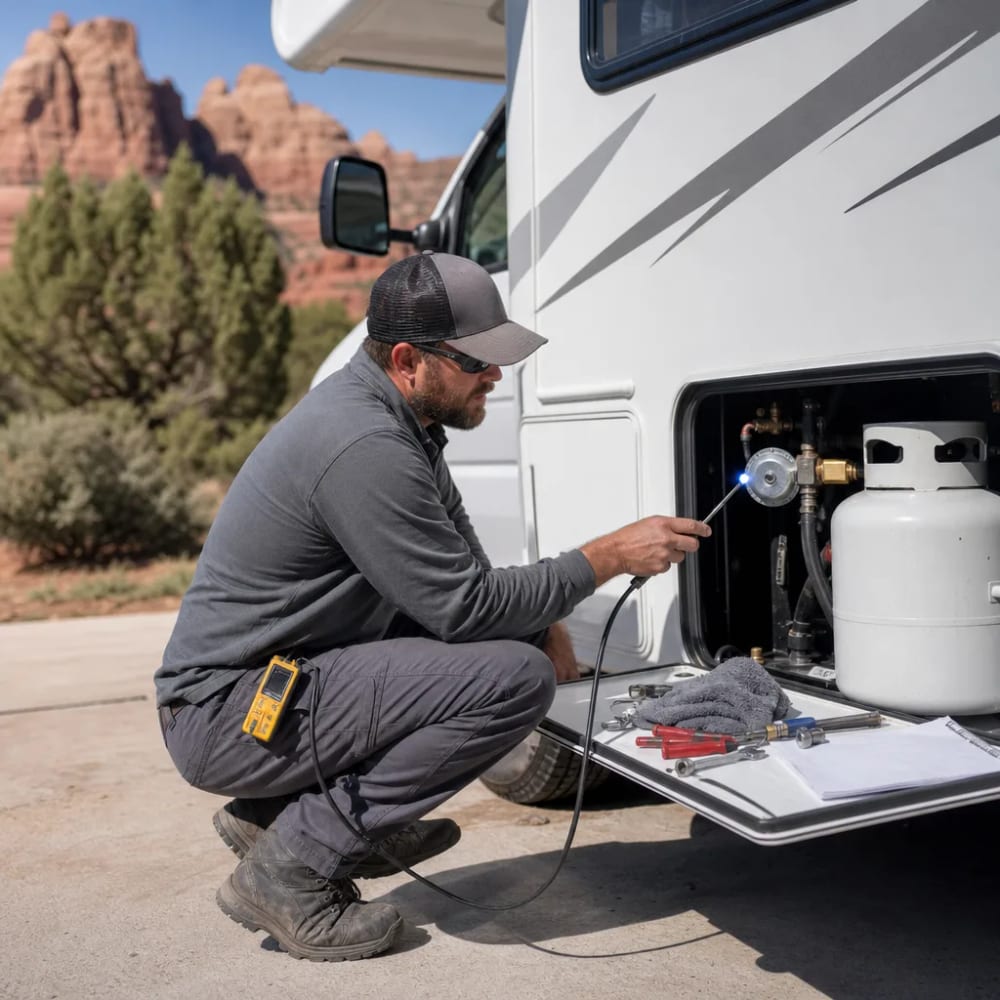
What an RV Propane Inspection and Leak Test Checks
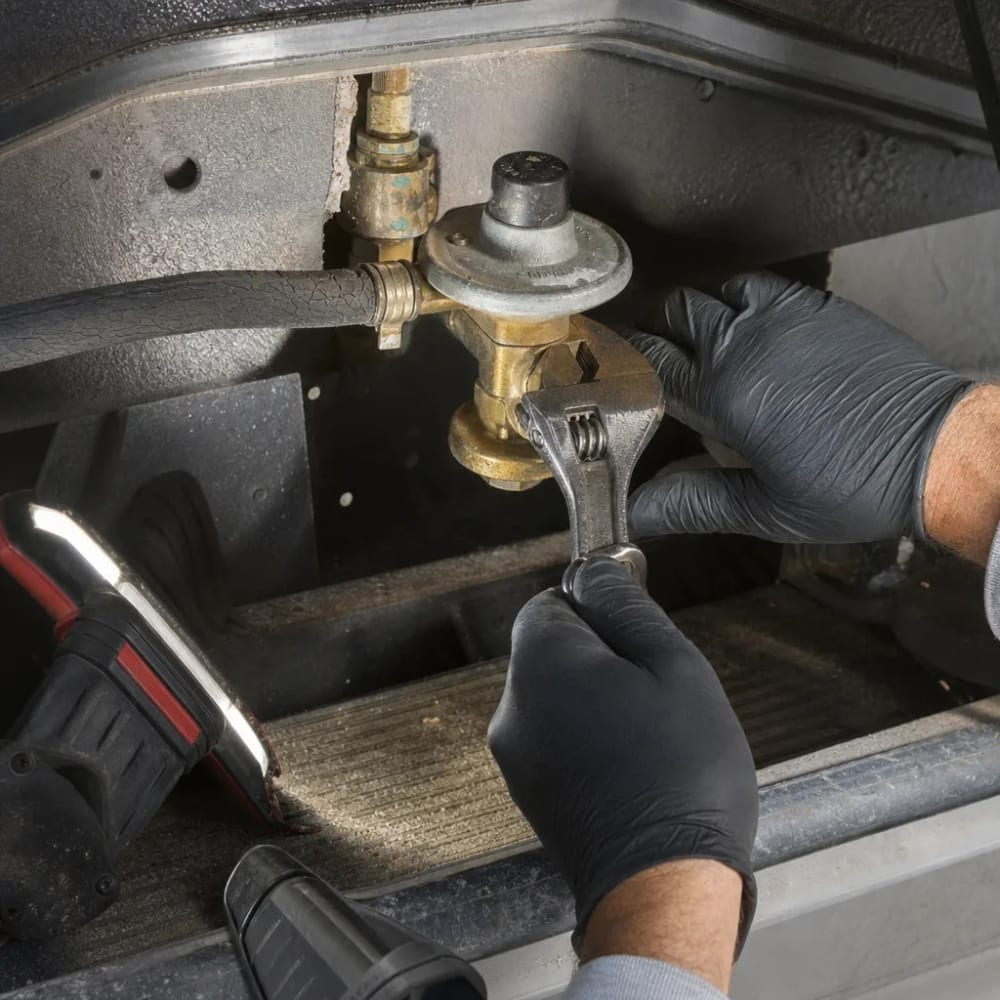
Here's the simple way to think about it. Propane starts in your tank, gets stepped down by the regulator, and travels through hoses and hard lines under the floor. It ends up at your furnace, water heater, fridge, and stove. A leak can hide anywhere along that path. So a proper inspection walks the whole route, start to finish.
- Tanks or cylinders: dents, rust, damaged valves, and whether the mounting is solid. A tank that rattles in its bracket is a tank that's slowly working its fittings loose.
- Regulator: condition, vent direction, and whether it's putting out the pressure the manufacturer calls for. Regulators wear out quietly, and a tired one can make every appliance act up at once.
- Pigtails and hoses: cracks, stiffness, and sun damage. Rubber doesn't love years of UV and temperature swings, and it won't send you a text when it gives up.
- Lines and fittings: the hard lines under the rig and every connection point, checked for corrosion, rub spots, and loose joints. Road vibration is hard on these.
- Propane detector: does it work, and is it past its useful life? Detectors have an expiration date, and plenty of folks never knew that.
- Appliances: each one lit and watched. A good blue flame, clean ignition, and no burner that sputters, lifts, or burns yellow and lazy.
Then comes the part that makes it a leak test and not just a look-see. The system gets pressurized and monitored with a gauge to see if it holds. If the pressure drops, something's leaking, even if it's too small to smell. From there, it's a matter of tracking down the exact fitting or line, usually with a leak-detection solution that bubbles where gas escapes.
“Your nose is a decent alarm, but it's a lousy gauge. By the time you can smell a leak, it's been leaking for a while.”
That pressure test is the piece most people skip when they check things themselves. Spraying soapy water on the fittings you can reach is a fine habit, but it won't find a slow leak in a line tucked behind a cabinet or under the floor. A gauge doesn't care where the leak is hiding. It just tells you the truth.
Picture this. You bought a used fifth wheel, the fridge works on electric, and the stove lights fine. But the furnace takes three tries and you catch a faint smell in the front compartment now and then. Is it the furnace, a loose fitting, or a regulator on its way out? Guessing gets expensive. A full inspection answers it in one visit and tells you what's wrong, not just what's annoying.
When it's done right, you should walk away knowing three things: the system holds pressure, every appliance burns the way it should, and anything worn out has been pointed out before it becomes a problem on a cold night miles from help.
Signs You Should Stop and Get a Leak Test Now
Some propane problems can wait for your next scheduled check. Others can't. Here's how to tell the difference. If any of these show up, quit using propane in the rig until a leak test proves the system is tight.
- You smell rotten eggs. Propane has no smell of its own, so a smell is added on purpose to warn you. If you catch it inside the coach or near a compartment, believe it. Don't talk yourself out of it because it comes and goes.
- Your propane detector goes off. A detector that alarms isn't being dramatic. Follow the steps in your detector's instructions and your owner's manual. Then get the system tested before you light anything again.
- You hear a hiss near the tank, regulator, or a fitting. Gas escaping under pressure can make a faint hiss you'll only notice when the generator and fans are off.
- Flames look wrong. Yellow, lazy, or lifting flames, or a burner that sputters, often point to a pressure or supply problem. It might not be a leak, but it's worth proving one way or the other.
- You see soot. Black marks around a furnace vent, water heater door, or above the stove mean something isn't burning clean.
- A tank is emptying faster than it should. If you filled up last week and barely ran the furnace, that propane went somewhere.
Then there are the times when nothing seems wrong, but a test is still smart before you head out.
- After you hit something underneath. A curb, a rock, a washed-out dirt road. The hard lines run under the floor, and they don't always show damage from the outside.
- After a long sit. A rig parked for months can come back with dried-out hoses, critters nesting where they shouldn't be, or a regulator that's lost its spark.
- After any propane work, even your own. If you swapped a pigtail or a regulator, a pressure test is how you know the new connection is sealed. Hand-tight is a feeling. Holding pressure is a fact.
- After you buy a used RV. You don't know how the last owner treated it, and their idea of a well-cared-for rig might be different from yours.
Here's one we'd want every RVer to hear. A couple pulls in after a long drive, gets set up, and notices a faint smell by the front compartment. It's late, they're tired, and it goes away when the door's closed. So they figure it's probably nothing and run the furnace all night. Maybe it was nothing. But "probably" is a lousy word to sleep next to. A ten-second smell is your rig asking for a gauge, not a guess.
If a warning sign shows up while you're parked at a campground or on a trip, you don't have to tow the rig anywhere to get answers. That's what our Emergency Mobile RV Repair and On-Site Campground RV Repair services are for.
One honest note. A single hard-to-light burner on an old stove doesn't always mean a leak. Sometimes it's just a dirty igniter or a burner that needs cleaning. But if it comes with a smell, an alarm, or soot, don't sort it out by trial and error. A leak test settles it fast and gives you something better than hope: a system you know holds tight.
When You Do Not Need a Full Inspection
Not every propane hiccup calls for the whole system to be tested. If none of the warning signs above are showing up, here are the times you can save your money, handle it yourself, or call for a smaller fix instead.
- Your fridge quit on electric but runs fine on propane. That's an electrical problem, not a gas problem. The propane side is doing its job. Start with the fridge's electric heating side, the outlet, or the breaker, not the gas lines.
- You just ran a tank dry and refilled it, and now the water heater or furnace won't light on the first try. Air got into the lines when the tank emptied, and it takes a minute for propane to push it back out. Your owner's manual covers how to bleed that air through. If everything lights and burns clean once the gas reaches it, you're good.
- You swapped a full cylinder onto the same pigtail. You didn't change any parts, so you don't need a full workup. Brush some leak-detection solution on that one connection after you open the valve. No bubbles, no problem. Changing a pigtail or regulator is different, and that's covered above.
- Your detector is chirping, not alarming. A steady chirp often means low power or that the detector has reached the end of its life. Check the manual to see which one it is. An old detector needs to be replaced, not the whole system tested. A real alarm is a different story.
- Your system was tested recently and nothing has changed since. If it passed a pressure test and you haven't hit anything underneath, let it sit for months, or had any work done, you don't need to test it again just for peace of mind.
Timing matters too. If you're parking the rig for the season with the tanks shut off, testing it the day you park doesn't do much. Things change while it sits. Hoses dry out, and mice decide your compartment is a five-star hotel. Do the test before you head out again, when the result will still be true.
Here's a real-life example. Someone calls in a panic because the fridge died on the way home. They're sure it's a gas leak. But the fridge works fine on propane and only quit on shore power. No smell, no alarm, no soot. That's a fridge repair, and paying for a full propane inspection to learn that would just mean paying for good news you didn't need.
So here's the rule we'd give a friend. If the problem stays in one appliance, follows a clear cause like an empty tank or a dead outlet, and doesn't come with a smell, an alarm, a hiss, or soot, fix that one thing. If you can't explain what's going on, or one of those warning signs shows up, then you need the gauge and not a guess.
Leak Test vs. Propane Tank Recertification
These two get mixed up all the time, and it's easy to see why. They both involve your propane tank, and they both sound official. But they answer two different questions. Recertification asks whether this cylinder is still safe to fill. A leak test asks whether your whole propane system is sealed from the tank to the burners. Passing one tells you nothing about the other.
Recertification, also called requalification, applies to the portable cylinders. These are the kind most travel trailers and fifth wheels carry up front, and you can pull them off to take to a fill station. Each one has a date stamped on the collar near the valve. These cylinders have to be requalified on a schedule after that date. If yours is out of date, the fill station can turn you away. A propane supplier or another qualified requalifier inspects the cylinder and, if it passes, stamps it with a new date.
Motorhomes usually work differently. Most have a tank that's permanently mounted to the frame and filled right where it sits. That kind of tank isn't requalified on the same date-stamp schedule as a portable cylinder. So if you drive a Class A or Class C, the stamp question may not apply to you at all. Your owner's manual or the tank's data plate will tell you which type you have.
Here's the part that trips people up. A recertified cylinder is a good cylinder. That's all it is. The new stamp doesn't check the regulator, the pigtails, the hard lines under the floor, or the fitting behind the stove. Your bottle can be brand new and your system can still leak. It's like getting a new gas can and assuming the lawn mower's fuel line is fine. One doesn't vouch for the other.
It works the other way too. A system can pass a pressure test with flying colors while one of the cylinders is past its date. Everything's sealed tight, but you won't get a refill until that bottle's requalified or replaced.
- Fill station refused your cylinder over the date? That's a recertification issue. Take it to a propane supplier or swap it out.
- Smell, alarm, soot, or a tank that's emptying too fast? That's a leak test, whatever the date stamp says.
- Just swapped in a newly recertified or brand-new cylinder? Brush leak-detection solution on that connection like you would after any swap. If you also replaced a pigtail or regulator, get the whole system pressure tested.
A quick story that shows the mix-up. Someone gets their cylinders recertified before a spring trip, sees the fresh stamps, and figures the propane side is handled. Then the furnace starts acting funny the first cold night out. The tanks were never the problem. A cracked pigtail was. The stamp was honest. It just wasn't answering the question they needed answered.
So check your date stamps every year, because a refused fill is a lousy way to start a trip. Just don't let a shiny new stamp stand in for the gauge. The stamp is about the bottle. The pressure test is about everything the gas touches after it leaves the bottle, and that's where leaks like to hide.
Why Timing Matters Before Heading Out of Cedar City

A leak test tells you the truth about your propane system on the day it's done. That's why when you schedule it matters almost as much as getting it done at all. Book it too early and things can change while the rig sits. Book it too late and you've got no room to fix what turns up.
The worst time to find out your regulator is tired is the morning you're hitching up. We've all been there in some form. The cooler's packed, the kids are buckled in, and the dog has already claimed the good seat. Now you're choosing between a trip without heat or hot water and a trip you're not sure is safe. Neither one is a fun way to start a vacation.
Here's the timing we'd give a friend:
- Schedule a week or two before you leave. That gives time to replace a pigtail, regulator, detector, or section of line if one fails, and then pressure test the system again so you know the fix held.
- Pair it with your spring start-up. If the rig sat all winter, the propane check fits right in with RV De-Winterization / Spring Start-Up, since you're already waking the whole coach up.
- Test before the first trip where you'll lean on the furnace. A furnace that barely runs in summer can hide a problem that shows up the first cold night out.
- Book it after any work or bump underneath, then leave a little buffer before departure. A fix is only finished once the gauge says so.
A quick story that shows the difference a few days makes. Say you've got a long weekend planned. You get the system checked on Monday, and the test shows a slow pressure drop. It gets tracked to a cracked hose, the hose gets replaced, and the system gets tested again. By Friday you're rolling out with nothing on your mind but where to eat. Now run that same story with the test on Thursday night. Same cracked hose, but now it's a scramble, and you're either rushing the fix or rushing the decision.
It also helps to skip the trip to a shop. If your rig is parked at home or in a storage lot around Cedar City, our RV Repair at Home or Storage Lot service means we come to it. You don't have to tow anything anywhere or wonder if that faint smell is going to follow you down the road. If you'd rather not track the calendar yourself, a Pre-Trip RV Inspection or our Seasonal RV Inspection Membership can put the propane check on a regular rhythm alongside everything else on the rig.
Our lead tech is an RVTI Certified Technician with more than 15 years in the RV industry, and that experience boils down to one practical habit: test early enough that a bad result is just a to-do item, not a canceled trip. One note so there are no surprises. We don't currently do manufacturer warranty work, so if your rig is still covered and the repair falls under that coverage, check with your dealer first.
Got a trip on the calendar? Give us a call and let's get your propane system tested while there's still time to fix whatever we find.
Call nowFrequently Asked Questions
Can I detect a propane leak myself before calling for a test?
You can catch some clues yourself, but you can't fully clear your system without a pressure test. Watch for a rotten egg smell, a hissing sound near the tank or fittings, soot around the stove or furnace vent, and a tank that empties faster than normal. Soapy water on fittings you can reach will show bubbles on an active leak. But a slow leak hiding under the floor or behind a cabinet won't show up that way, which is why a gauge test matters.
How do you test a propane line for leaks the right way?
The right way is to pressurize the whole system and watch a gauge to see if it holds steady. If the pressure drops, gas is escaping somewhere, even if it's too small to smell. From there, leak-detection solution gets brushed on fittings and lines to spot exactly where bubbles form. This finds leaks hiding behind cabinets or under the floor that a simple sniff test or soapy-water check on visible fittings would miss.
What should I do right away if my RV propane detector goes off?
Follow the steps in your detector's instructions and owner's manual right away, and don't light anything until the system is tested. A real alarm means gas may be present, not a false alarm to ignore. Once you're clear of danger, a pressure test will confirm whether there's an actual leak and where it is before you use propane again.