
RV Ventilation Fan Repair · Cedar City, Utah
RV Ventilation Fan Repair in Cedar City, Utah: Fix It or Replace It?
Decide Between Repair and Replacement
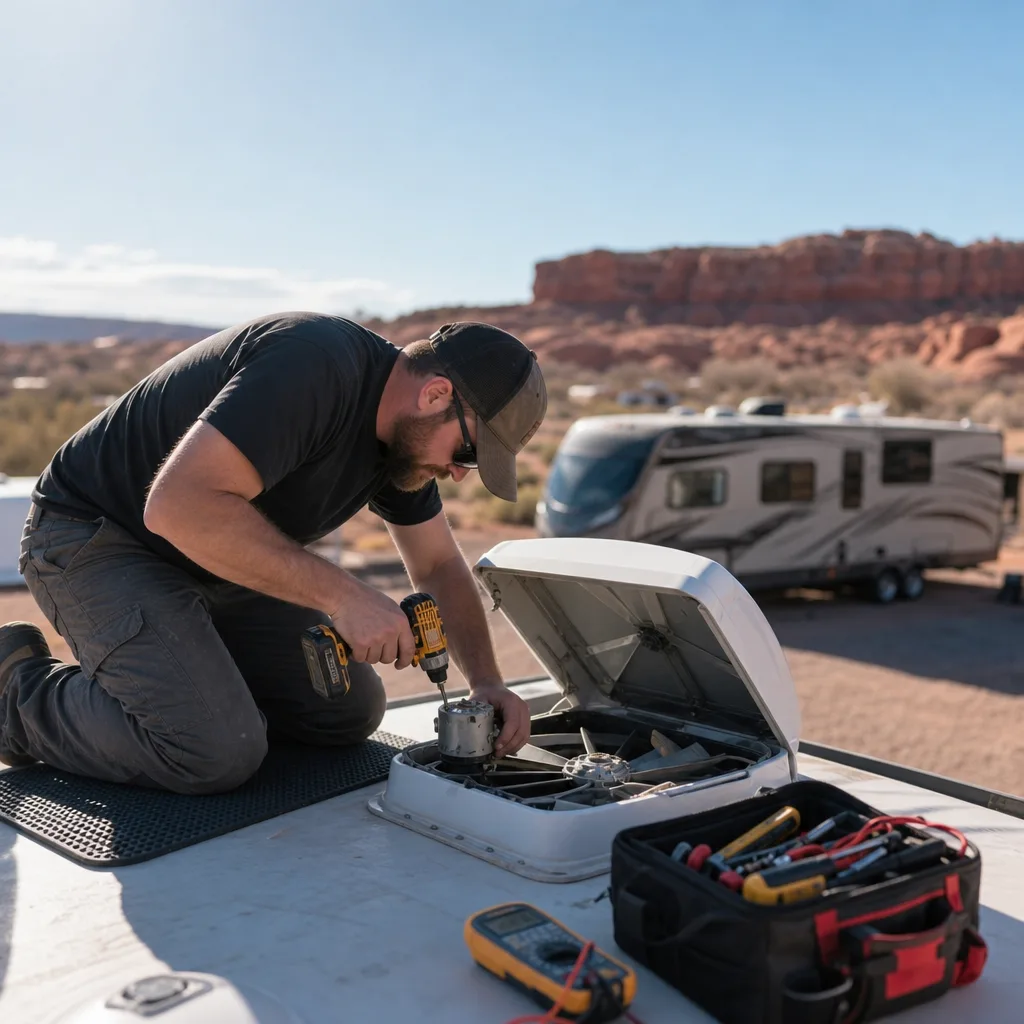
Here's how we think about it. A roof vent fan is a simple machine: a 12-volt motor, a blade, a switch, a lid that cranks open, and a frame sealed into a hole in your roof. When one of those pieces quits, you don't always need a whole new fan. You just need the piece that quit.
Repair usually makes sense when:
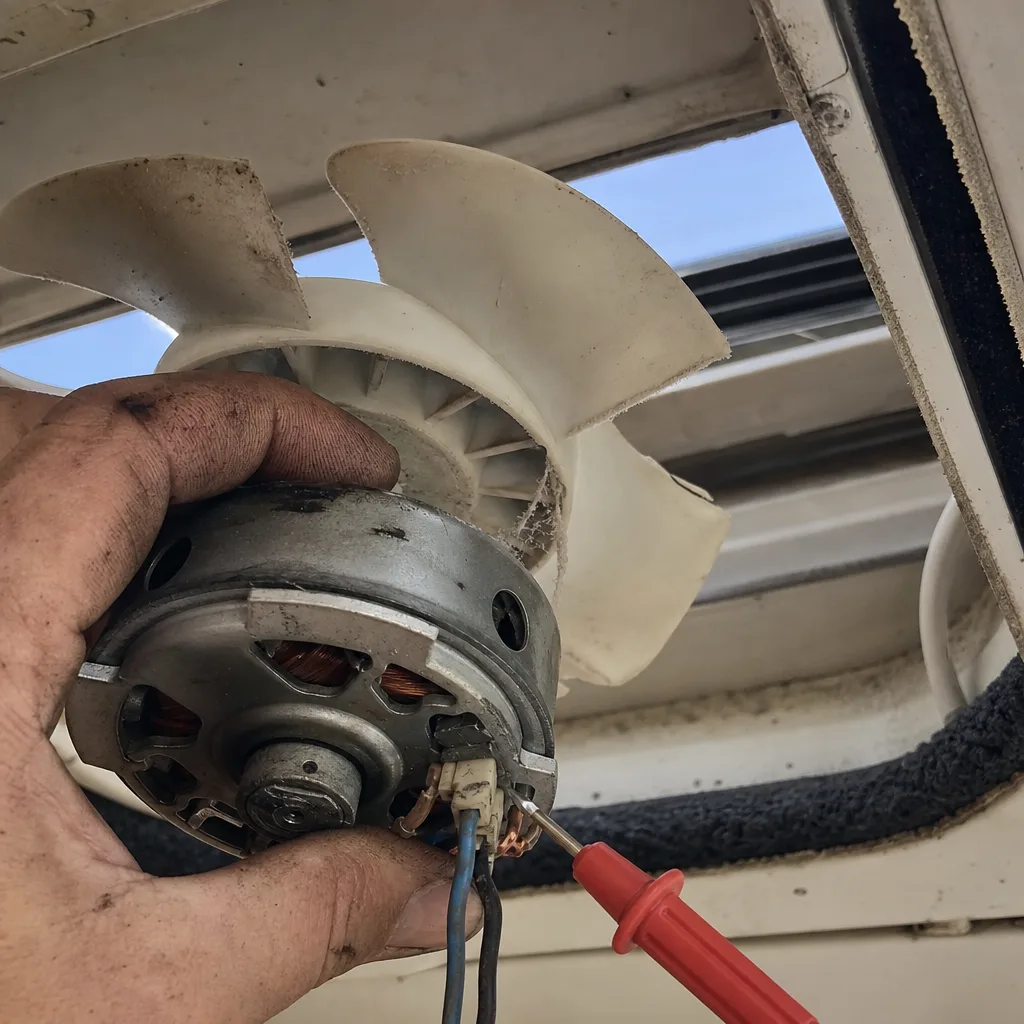
- The fan is dead but the lid and frame look solid. That often points to a fuse, switch, wiring connection, or motor.
- The blade spins but wobbles or clicks. A cracked or loose blade is a small part swap.
- The lid won't crank open or closed. Stripped gears and broken lift arms are common, and they're fixable.
- It only runs on one speed, or it won't shut off. That's usually a control or switch issue, not a whole-fan problem.
Replacement usually makes sense when:
- The dome lid is chalky, faded, or cracking. Plastic that's been cooked by the sun gets brittle, and our high desert sun doesn't go easy on it. A cracked lid lets water in, and patching it doesn't last.
- The base frame or flange is cracked. The frame is what holds the seal, so if it's broken, the seal can't do its job.
- There are water stains on the ceiling around the vent. At that point we're fixing a leak, not just a fan.
- Parts for your model are hard to find, or the fan is old enough that a new one costs less than chasing parts for it.
- You want an upgrade, like more speeds, a reverse setting to pull air in, a thermostat, or a rain sensor that closes the lid for you.
Good news on the replacement side: most RV roof vents use a standard-size opening, so a new fan often drops into the same hole. We'll still check yours before anyone orders anything. Guessing on that is how a fan ends up spending a month in the garage as a very expensive paperweight.
So what drives the cost? A few things, either way:
- The part itself. A switch or gear costs far less than a full fan unit, and upgraded fans with sensors and remotes cost more than basic ones.
- Labor and access. A simple swap from inside the coach goes fast. Pulling the fan from the roof takes longer.
- The seal. Any time the fan frame comes off the roof, it has to be resealed properly. If the sealant around other roof fixtures is tired too, that's a job for our RV Roof Resealing service, and it's worth doing while someone's already up there.
- Water damage. If the ceiling or roof decking under the vent is soft, that changes the job.
Before you hire anyone, ask them three things. What exactly failed? Is the frame and seal still good? Does the repair cost come close to a new fan? An honest answer tells you which way to go. If the motor's fine and only the switch died, nobody should be selling you a whole new fan.
Spot the Signs Your Vent Fan Needs Attention
A vent fan rarely dies all at once without warning. It usually drops hints first. You'll hear a noise, notice it's moving less air, or see a little water where water shouldn't be. Catch those early and you're usually looking at a small fix. Ignore them and the fan isn't the only thing that pays.
Here's what to watch for:
- It won't turn on at all. You flip the switch and get nothing. That can be a fuse, a switch, a loose wire, or the motor itself.
- It runs, but weakly. The blade turns slow or the air barely moves. A tired motor can do this, and so can a low house battery, since these fans run on 12 volts.
- It's making new noises. Grinding, squealing, rattling, or a steady click usually means a worn motor, a loose or cracked blade, or something rubbing that shouldn't be.
- It won't stop, or it's stuck on one speed. The fan still works, but the controls don't listen anymore.
- The lid won't open or close. The crank spins freely, or it fights you the whole way. That's usually the gears or the lift arm.
- It spins but you can't feel much air. Check the screen. Dust, bugs, and cooking grease can clog it until the fan is basically stirring the air in its own little box.
- You smell something hot or burning when it runs. That points to a motor or wiring problem, and it's worth getting looked at soon.
Some signs don't come from the fan at all. They come from the air inside your RV. If you wake up to foggy windows, or the bathroom mirror stays steamed long after your shower, moisture isn't getting out. Same goes for cooking. If you fried bacon this morning and the whole trailer still smells like breakfast at dinner time, your fan isn't doing its job. Trapped moisture is how you get musty smells and mildew in the corners, and nobody wants a camper that smells like a damp gym bag.
Now the one that matters most: water. A drip from the vent during a storm, a brown ring on the ceiling around the fan, or a soft spot in the ceiling nearby all mean water is getting past the lid or the seal. The fan might still run perfectly, and you've still got a problem. Out here, a dome lid that's been baking in the high desert sun for a few seasons can look fine from inside and be chalky and cracked on top. Take a look from a ladder if you can do it safely, or have someone check it for you.
When you call about any of this, it helps to tell us a few things. Does the fan do anything at all? Do your other 12-volt things, like lights and the water pump, work fine? Have you seen water, and when? Those answers point us toward the right part before we ever climb up there. They also tell us whether we're chasing a fan problem or a roof problem wearing a fan costume.
Check These Before Booking a Repair Call
Plenty of dead vent fans aren't broken at all. Before you book anyone, including us, run through a few quick checks. They take about ten minutes, you don't need tools for most of them, and you don't need to climb on the roof for any of them. If one of these fixes it, you just saved yourself a service call, and we're genuinely happy about that.
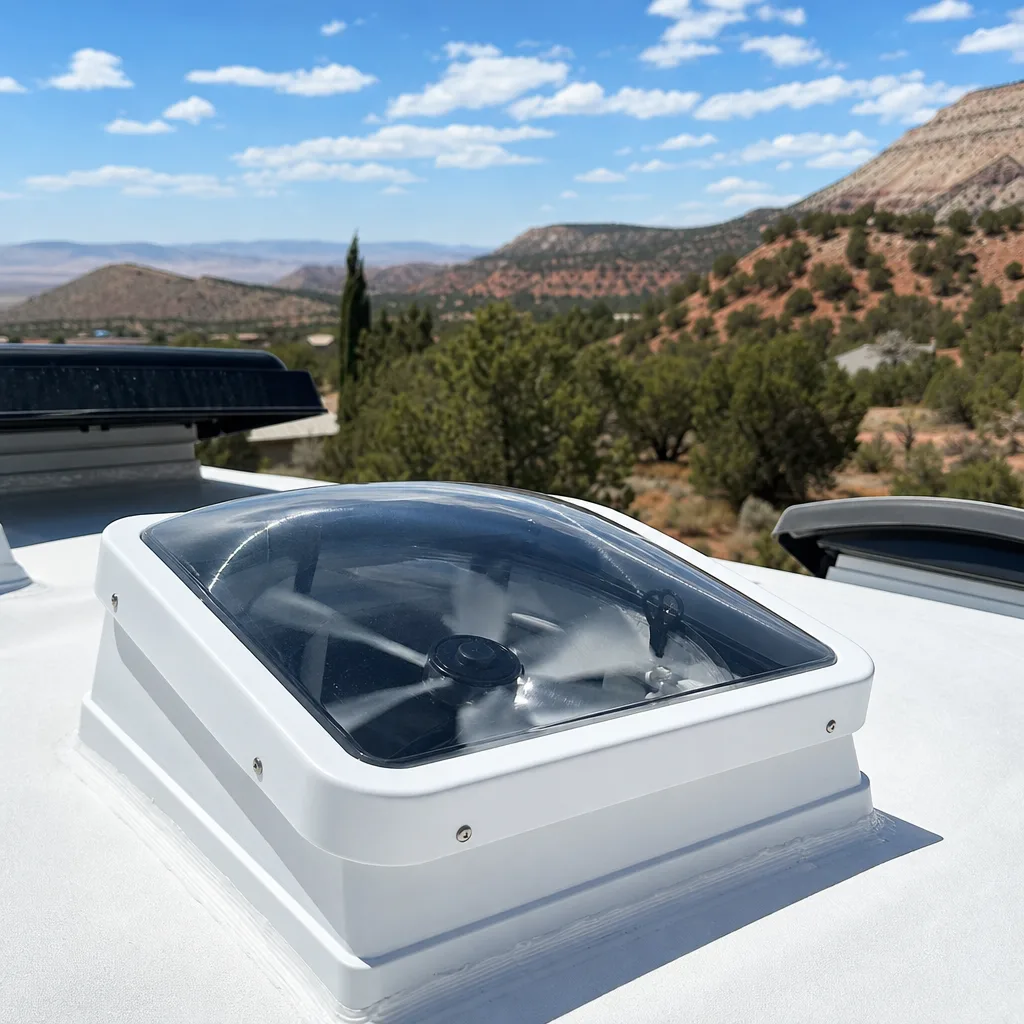
- Open the lid all the way. Many fans have a safety switch that keeps the motor off until the lid is open. A lid cracked open an inch can look open from below and still keep the fan from running.
- Check both switches. A lot of fans have a power switch on the fan housing itself and a separate one on the wall or panel. If either one is off, nothing happens. It's the RV version of "is it plugged in?" and it catches more folks than you'd think.
- Look at the fuse. Find your 12-volt fuse panel, check the fuse for the fan circuit, and swap it if it's blown. A new fuse that blows again right away is your cue to stop and call. It means something's shorting.
- Make sure your house battery has some juice. If the lights are dim and the water pump sounds tired, the fan isn't the problem. Charge up or plug into shore power and try again.
- Check the thermostat setting. Fans with a built-in thermostat won't run if the inside of the coach is cooler than the setting. On a cool high desert evening, that fan may simply think it has the night off.
- Give the rain sensor a minute. Fans with a rain sensor close the lid and stop when the sensor is wet. If it rained or the dew is heavy, let the sensor dry before you decide anything's wrong.
- Try fresh batteries in the remote. If your fan uses one, a dead remote can look exactly like a dead fan.
If the screen's clogged, clean it before you judge how well the fan moves air, like we covered above. And if the crank fights you, don't force it. Cranking harder on stripped gears or a bent lift arm can turn a small parts job into a bigger one, and the lid can end up stuck partway open right before a storm.
There are also times you should skip the checklist and call. If you see water coming in, smell something hot or burning, or a fuse keeps blowing, leave the fan off and get it looked at. Those aren't things to keep testing.
One more thing to know up front: if your RV is still under the manufacturer's warranty and you want the repair covered, that work goes through an authorized dealer. We don't currently do manufacturer warranty work. For everything else, we're glad to help.
If you've gone through the list and the fan still won't cooperate, you've already done the easy part. When you call, tell us which checks you tried and what happened. That saves us both time and gets us to the part that failed.
Call nowKnow When a Stuck Fan Can't Wait
Not every fan problem is urgent. A fan that's noisy, weak, or stuck on high is annoying, but you can usually live with it for a few days. The calls that can't wait are about where the lid is stuck and what's coming next. A lid stuck in the wrong position at the wrong time turns a small parts job into a roof, ceiling, or comfort problem fast.
Here's how we'd sort it:
- Lid stuck open with weather coming. This is the big one. An open vent is a hole in your roof with a lid politely waving at the sky. A summer storm that rolls in over the hills or a night of snow can soak your ceiling, mattress, or cabinets before you know it. Get it handled before the weather shows up.
- Lid stuck open while the RV sits in storage. Nobody's there to notice the rain, dust, bugs, or curious birds. A camper parked on a storage lot with an open vent is collecting all of them.
- Lid stuck closed in hot weather. If you're staying in the coach, especially with pets, losing your main exhaust fan in the heat matters. Heat builds up quickly under a sunny roof, and the AC has to work harder with no way to push hot air out.
- Bathroom or kitchen fan dead on a long stay. One weekend is fine. Weeks of showers and cooking with no exhaust is how moisture problems settle in.
- Trip leaving soon. If you roll out in a few days, now is the time. Fixing a crank gear in your driveway beats finding a fix in a campground two hours from the nearest part.
If the lid's stuck open and rain is close, a vent cover or a weighted tarp can buy you time. Only do that if you can get up there safely. A wet, windy RV roof is no place for a hero move, and no vent is worth a fall. If you can't reach it safely, close the interior shade, put down towels, and call.
What can wait? A fan that runs but makes a little noise. One that's stuck on a single speed. A slow lid that still closes all the way. Those are worth booking, but you don't need to drop everything. Plan the repair around your next trip or your next roof check.
When it can't wait, we come to you. Our Emergency Mobile RV Repair is there for a lid that's stuck open with a storm on the way. If you're already camped, our On-Site Campground RV Repair means you don't have to pack up and tow anywhere with a hole in your roof. If the coach is parked at home or on a storage lot, we can do the work right there. As an RVTI Certified Technician with more than 15 years in the RV world, I'd rather take a quick look today than replace soggy ceiling panels next month.
Call nowWhat Happens During an On-Site Fan Repair Visit
We're a mobile shop, so the repair happens wherever your RV is parked. That might be your driveway, a storage lot, or your campsite. I'm the lead technician and the main person you'll talk to, so you're not explaining your fan problem three times to three different people. My wife sets the appointment and keeps the calendar straight, which is good news for everyone. My calendar skills are about as reliable as a cracked dome lid.
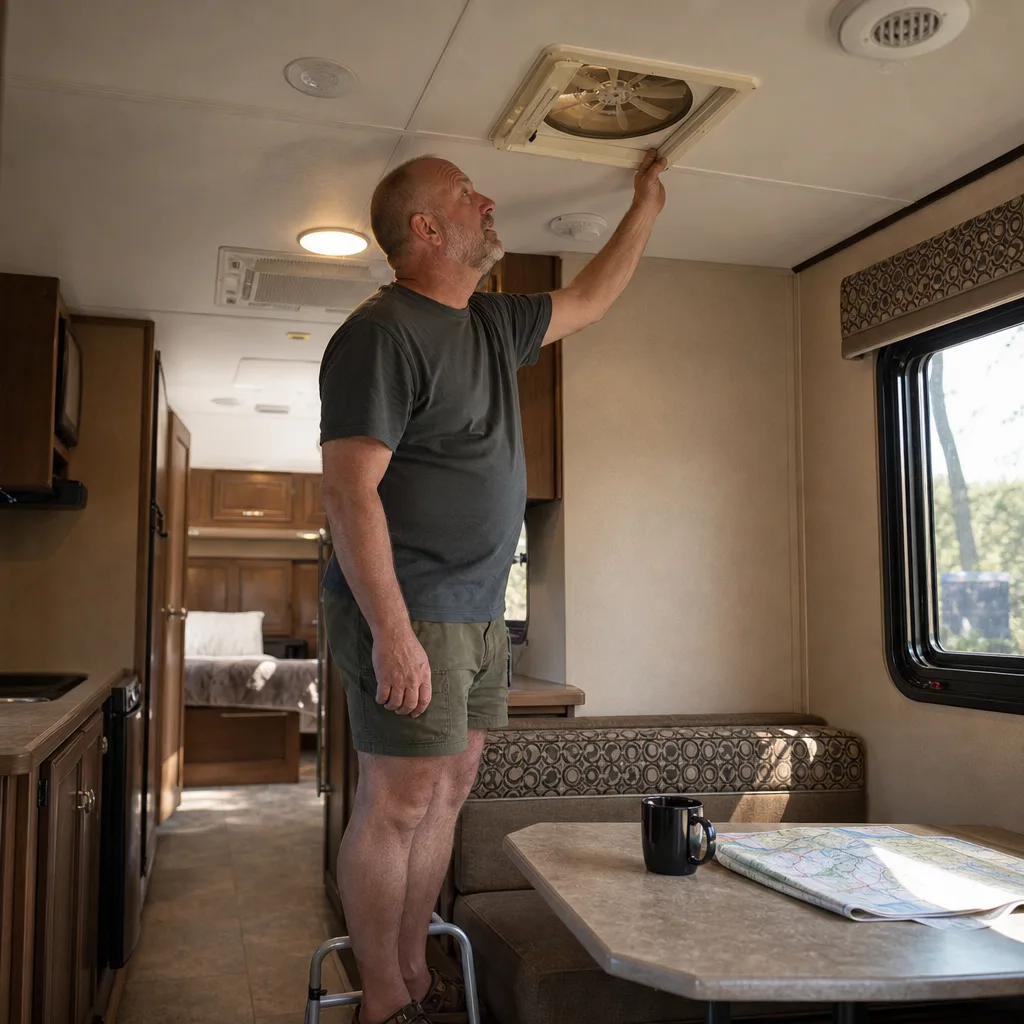
A few minutes of prep on your end makes the visit go smoother:
- Clear the space under the fan. Move bedding, dishes, or anything on the bed or counter below it. Old sealant, dust, and the occasional dead bug tend to fall out when a fan comes apart.
- Leave room for a ladder next to the RV. If it's squeezed into a tight row on a storage lot, tell us where it's parked when you book.
- Make sure we can get in. That means keys, and a gate code if the lot has one.
- Have power ready. A charged house battery or a shore power hookup lets us test the fan on real power, not a guess.
- Snap a photo of any label you can see on the fan housing. It helps line up the right part.
Here's how a fan repair should go, no matter who does it. It starts with finding what failed. Testing from the inside comes first: is power reaching the fan, do the switches work, is the fuse good, does the motor respond? Then comes the roof, to look at the lid, the hinge, the lift arm and gears, the dome plastic, and the sealant around the frame. Working in that order keeps anyone from hauling a new motor up a ladder when the real problem was a five-minute switch.
If the fan frame has to come off the roof, resealing it is part of the job, not an optional extra. A fan that runs great over a leaky seal isn't fixed. It's just a nicer-sounding leak.
Before anyone packs up, you should see the fan pass a few simple tests:
- It runs on every speed, and in both directions if it has a reverse setting.
- The lid cranks all the way open and closes snug, with no grinding or slipping.
- The thermostat and rain sensor respond, if your fan has them.
- The sealant around the frame is one continuous bead, with no gaps or bare spots.
- You know what failed, what got replaced, and why.
That last one matters. You should never walk away wondering what you paid for. As an RVTI Certified Technician with 15+ years in the RV industry, I'd rather show you the worn gear or the burned switch than just tell you about it. After the work's done, the invoice comes from our office, so you're not standing in the driveway sorting paperwork.
Call nowFrequently Asked Questions
Can springtails or bugs clog my RV vent fan screen?
Yes, bugs and debris are a common cause of a weak-feeling fan. Dust, insects, and even cooking grease build up on the screen until the fan is just stirring air inside its own housing instead of pulling it out. Cleaning the screen first is worth trying before you assume the motor is bad.
Will running my vent fan too much drain my RV battery?
A fan that seems weak or sluggish is sometimes a battery problem, not a fan problem. These fans run on 12 volts, so if your lights look dim or the water pump sounds tired, charge up or plug into shore power before judging the fan itself.
Is it normal for an RV vent fan to smell hot when it runs?
No, a hot or burning smell points to a motor or wiring problem and it's worth getting looked at soon. Don't keep running the fan hoping the smell goes away, since that usually means something is overheating inside the unit.
What if my RV roof vent is stuck open while it's parked in storage?
That's one of the situations that can't wait, since nobody is around to notice rain, dust, bugs, or birds getting in through an open vent. A camper sitting in a storage lot with a stuck lid collects all of that until someone checks on it or fixes the gears or lift arm causing the problem.