
RV Water Pump Repair and Replacement · Cedar City, Utah
RV Water Pump Repair and Replacement in Cedar City, Utah
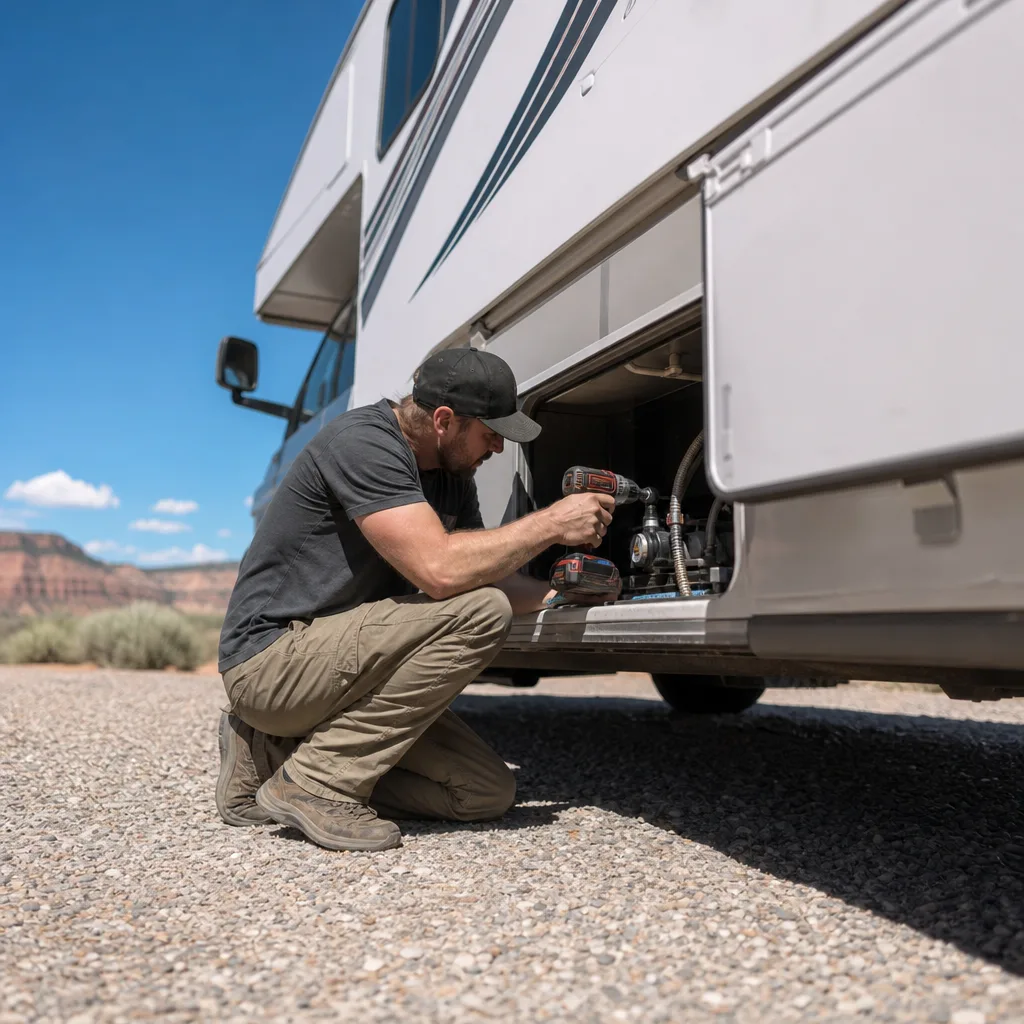
Repair or Replace: How the Decision Gets Made
Picture this. It's 2 a.m., everyone's asleep, and the water pump kicks on for two seconds. Then again twenty minutes later. And again. You lie there sure the pump is dying, and by breakfast you've ordered a new one. It shows up, you install it, and that night it's still cycling. The pump was never the problem. A slow drip under the bathroom sink was letting pressure bleed off, and the pump was just doing its job.
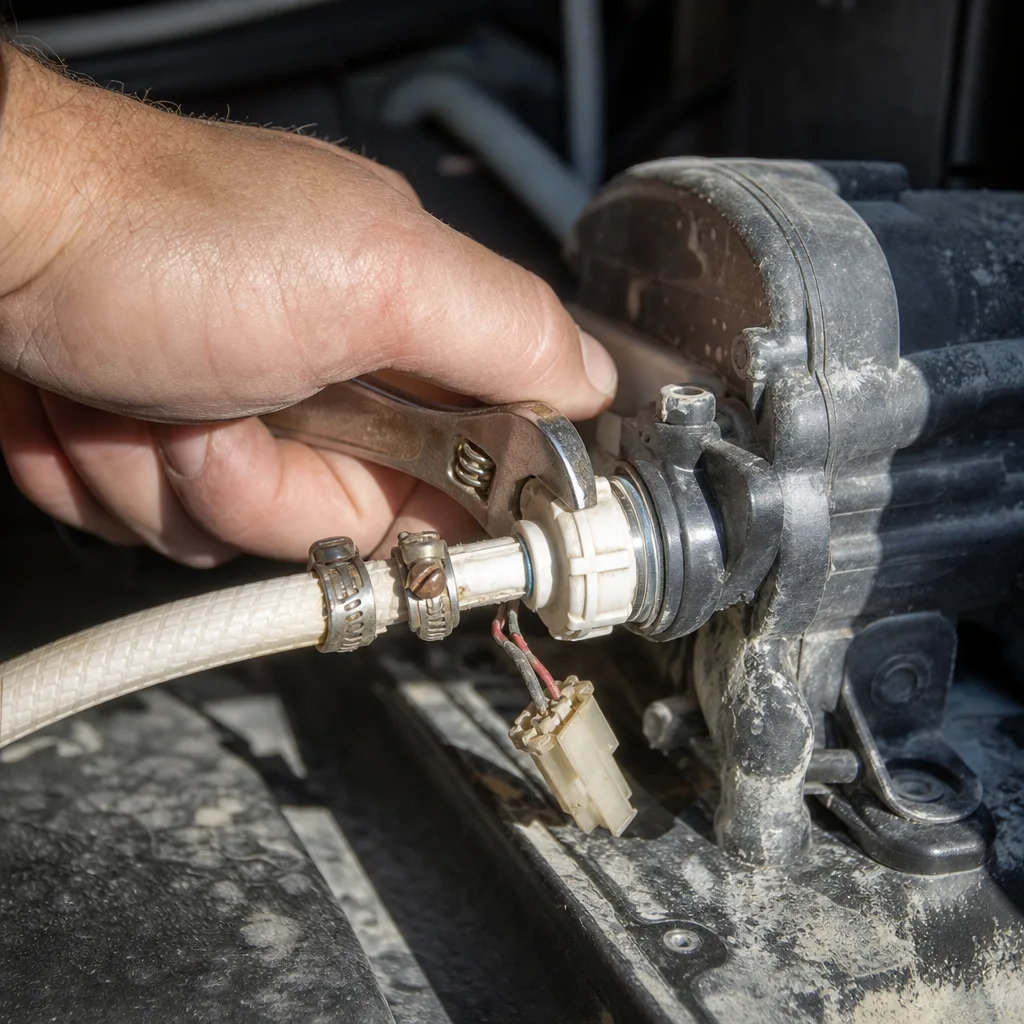
That's why we don't start with "new or fixed?" We start with "what broke?" An RV pump is a pretty simple machine: a 12-volt motor, a pump head with a diaphragm and check valves, and a pressure switch that tells it when to run and when to rest. Any one of those can fail on its own. So can everything around the pump, like the fuse, the wiring, the inlet strainer, and the fittings.
These problems usually point to a repair:
- The pump runs but never shuts off, or shuts off and won't restart. That's often the pressure switch.
- The pump cycles with every faucet closed. Look for a leak or a check valve that isn't sealing.
- The pump runs loud but gives you weak, sputtery water. A clogged inlet strainer or an air leak on the tank side is a common cause.
- Nothing happens at all. Check power first. A blown fuse, a loose ground, or a corroded connection can make a healthy pump look dead.
These usually point to a replacement:
- The motor is burned out, seized, or hums without turning.
- The housing or pump head cracked from freezing, and a replacement head isn't available or doesn't make sense.
- The pump is old and worn in several places, so the parts would cost close to a new pump.
- The model is discontinued and parts are hard to find.
Here's the honest math. Most of the work is finding the problem and getting to the pump, which tends to live in a cramped spot under a bed or behind a panel. That access and diagnosis time is about the same either way. So the real difference between a repair and a replacement is usually the price of a part versus the price of a whole pump. If a small part fixes a pump that's otherwise healthy, there's no reason to throw the rest away. If the motor's shot, patching around it is just paying twice.
Whoever works on your rig, ask three questions before you approve anything: What exactly failed? Can that part be fixed or swapped on its own? If not, why not? A good tech can answer all three in plain English. If the answer is just "it needs a new pump" and nothing more, keep asking.
Signs Your Water Pump Needs Attention
Your pump almost always tells you something's wrong before it quits. You just have to know what to listen, look, and feel for. Catch it early and you're usually looking at a small fix instead of a soggy floor.
Before you blame the pump, run through the easy stuff. We'd rather you save the service call if the answer is simple.
- Is there water in the fresh tank? The gauge can lie, so take a look if you can.
- Is the pump switch on? Kids, guests, and tired adults all bump it.
- Is the winterizing bypass valve still turned to the antifreeze line? If it is, the pump is pulling air instead of water from the tank. This one catches a lot of folks in the spring.
- Are you hooked to city water? If you are, the pump shouldn't be running at all, so leave it off.
If all of that checks out and something still seems off, these are the signs worth paying attention to:
- A new noise. RV pumps are never quiet, but they should sound the same every time. If it starts rattling, buzzing louder, or vibrating hard enough to rattle the floor, something changed. Sometimes it's just worn rubber mounting feet or a loose screw, which is an easy fix.
- Water where it shouldn't be. Damp carpet near the pump, a puddle in the compartment, or a floor that feels a little soft. A leak at the pump head or a fitting won't fix itself, and water sitting in an RV floor turns into rot faster than you'd like.
- Pressure that fades or pulses. You turn on the faucet, get a good blast, and then it drops off or comes and goes in waves.
- The pump runs, but nothing comes out. That means it's running dry, which wears out the inside of the pump fast. Flip it off until you know why.
- Heat or a hot electrical smell. A pump that's too hot to keep your hand on, or smells like it's cooking, needs to be shut off now.
- The same fuse keeps blowing. One blown fuse can be bad luck. A new one that blows again usually means the motor is pulling more power than it should.
Here's the one we'd watch for most. Your rig spent a Cedar City winter parked at the storage lot. Spring shows up, you fill the tank, flip on the pump, and it runs and runs without building pressure. Then you notice a drip coming from under the bed. That's often freeze damage at the pump or a fitting near it, the kind of crack covered above. Turn the pump off before it empties your tank onto the floor.
If you'd rather have someone handle the whole spring wake-up, we also do RV de-winterization and spring start-up.
None of these signs means you need a new pump. They mean it's time to find out what failed while the list is still short. The pump that buzzes a little funny in May is a lot cheaper to deal with than the one that gives out halfway to Brian Head with a full tank and no water at the sink.
When It Is Not the Pump
A lot of water problems get blamed on the pump because it's the part you can hear. But the pump only pushes water. If the trouble shows up in one spot, on one side, or only on certain days, there's a good chance the pump is fine and something downstream is the real problem. Here's how to tell before you spend money on a new one.
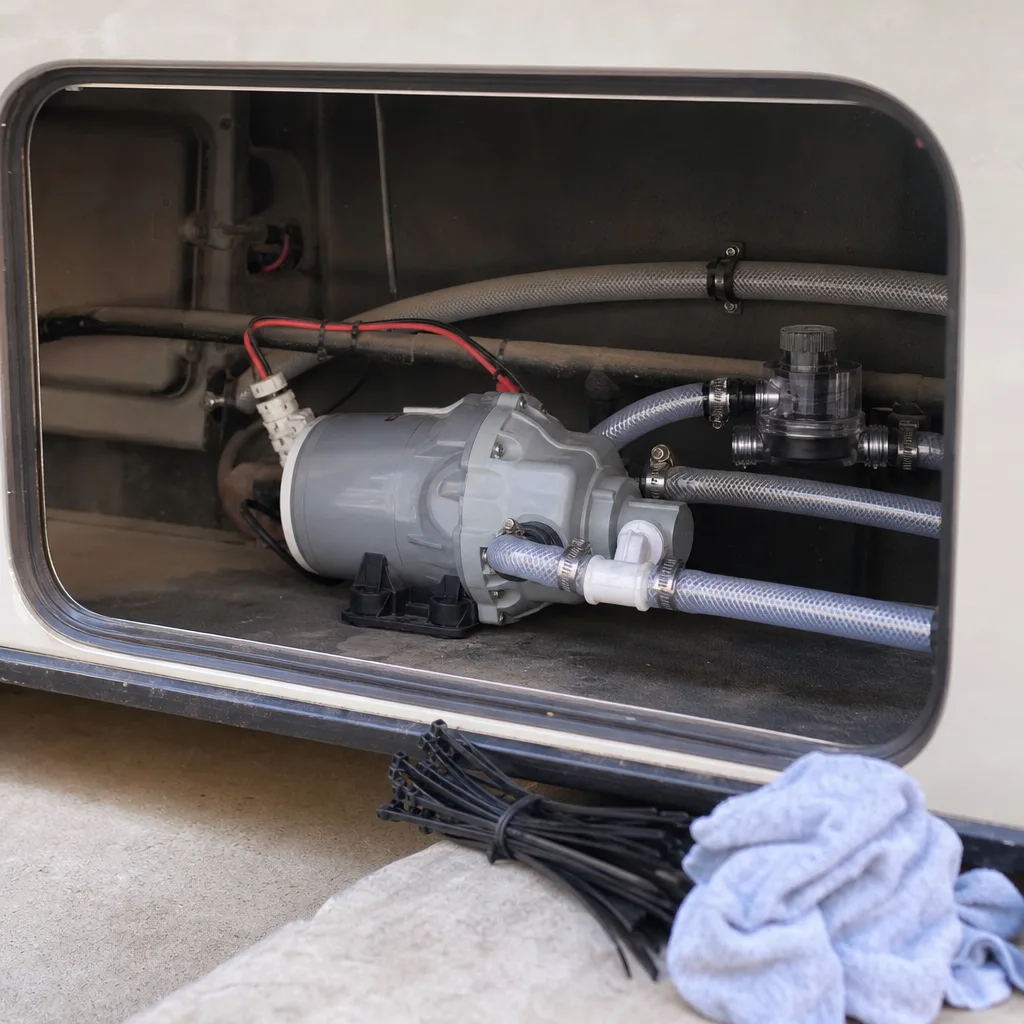
Start with one simple question: is the problem everywhere, or just in one place? A bad pump gives you a weak flow at every faucet, the shower, and the toilet. If the kitchen sink is a trickle but the bathroom sink is fine, the pump isn't picking favorites. Look at that one fixture instead.
- One faucet is weak. Unscrew the aerator on the end of the spout and look inside. Bits of grit, plastic, and mineral flakes collect there, especially after a tank fill or a de-winterize. Rinse it, screw it back on, and you're done. A weak shower head works the same way.
- Only the hot side is weak. That points to the water heater, not the pump. A water heater bypass left partly open, or buildup in the heater, can choke the hot side while the cold side runs strong. That's an RV water heater repair job, not a pump job.
- Everything got weaker a little at a time. If you've got an inline water filter, check the cartridge. A clogged one slowly cuts pressure to the whole rig and fools a lot of people into thinking the pump is wearing out. Swap the cartridge and test again.
- The pump sounds slow and tired. A 12-volt pump runs on your house batteries. When the batteries are low, the motor slows down and the water pressure drops with it. Charge up or plug in, then try again. If the pump perks right up, the pump was never the issue. The batteries or the charging system are.
- Pressure is bad on city water. The pump is off when you're hooked to city water, so it can't be the cause. Look at the park's spigot, your hose, and your pressure regulator. A kinked hose or a worn-out regulator is a cheap fix.
Toilets fool people too. If the toilet won't fill but every faucet works fine, the problem is the toilet's water valve, not the pump. That's a plumbing fix.
Here's a quick test that settles a lot of arguments. Turn on the pump with every faucet closed and let it build pressure and shut off. Then open the faucet closest to the pump. Strong steady flow there but weak flow farther away? The pump is doing its job and the trouble is somewhere in the line or at the far fixture. Weak at the closest faucet too, with full batteries and a clean filter? Now the pump is worth a closer look.
If one of these fixes it, great. That's money you get to keep, and nobody had to crawl under your bed. Swapping a pump that wasn't broken just means you've got the same problem and a spare pump in a box.
Why Water Pumps Often Fail at Spring Start-Up
Spring is when a lot of pumps seem to die. Most of them didn't wear out over the summer. They sat still for months, and winter worked on everything around them. That's good news, because a lot of spring pump trouble comes from a part that can be cleaned, freed up, or swapped on its own.
Here's what a long Cedar City storage season does to a water system:
- Water hides in the pump head. Blowing out the lines with air clears the pipes, but the pump can still hold a little water inside. A little is all it takes to cause the freeze crack we covered earlier.
- Antifreeze and gunk settle out. If the pump pulled pink antifreeze through the system last fall, some of it lingers. Add tank sediment, and the inlet strainer can clog the first time you run fresh water through it.
- Rubber parts sit dry and stiffen. The diaphragm and check valves inside the pump haven't moved in months. They can stick or fail to seal at first, so the pump struggles to prime or cycles when it shouldn't.
- Batteries drain. A rig left with the batteries connected all winter can slowly run them down. A weak battery makes a healthy pump sound sick.
- Mice move in. To a mouse, a parked RV is a free hotel with snacks. They'll chew wiring and nest in warm compartments, and the pump area qualifies.
Then comes the first fill, and that's where some pumps get finished off. You flip the switch, the pump can't find water because the tank's low or the bypass is still set to antifreeze, and it runs dry while you go grab something from the truck. A few minutes of that is hard on the inside of a pump that was fine when you parked it.
So give your first start-up of the year a little attention. Fill the fresh tank well past the bottom. Make sure the bypass is set back to normal. Open one faucet before you turn the pump on, so air has somewhere to go. Then stay near the pump compartment for the first minute or two. You're listening for the pump to settle into its normal rhythm, and you're looking for any drip near the pump or its fittings. If it runs and runs with no water at the faucet, shut it off.
One owner might hear sputtering at first, then steady flow once the air works out of the lines. Nothing's broken. Another might hear the same sputter and then see a wet spot spreading under the pump. Same sound, very different problem. That's why we check what failed before anyone talks about a new pump.
Most spring pump trouble starts in the fall. If the pump head gets drained and the batteries get looked after before the cold sets in, April gets a lot less exciting. Our RV winterization service is built to handle that part, so the pump wakes up ready to work instead of ready for the trash can.
On-Site Diagnosis at Your Home, Storage Lot, or Campground
A water pump is easiest to figure out right where it's installed. Pull it out and haul it somewhere, or tow the whole rig across town, and you leave most of the clues behind. Those clues are the batteries that run it, the tank that feeds it, and the fitting that only drips once the lines are under pressure. That's a big reason mobile service makes sense for this job. Benny's RV is a mobile RV technician service here in Cedar City, so we come to your rig in your driveway, at a storage lot, or parked at a campground.

Here's who you'll be dealing with. I'm the lead technician, and I'm an RVTI Certified Technician with more than 15 years in the RV business. I started out washing trailers as a lot porter to pay for college, then worked my way through sales and sales management. Eventually I ran three locations as general manager before moving my family here. So the person who answers your questions about the pump is the same person who crawls under the bed to look at it.
A little prep on your end makes the diagnosis faster and keeps you from paying for time spent moving boxes.
- Leave some water in the fresh tank. A pump can't be tested dry, and running dry is how pumps get hurt in the first place.
- Charge the house batteries or have shore power ready, so a weak battery isn't mistaken for a weak pump.
- Clear a path to the pump. It usually lives under the bed or behind a panel, right behind the camp chairs, the spare bedding, and that box of stuff nobody remembers packing.
- Jot down what you noticed: the sound, when it started, and whether it happens on the tank, on city water, or right after spring start-up.
- At a storage lot, find out whether you need to be there to open the gate or unit, and check that the lot allows work on site.
- At a campground, have the campground name and your site number handy.
One thing to know up front. We don't currently offer manufacturer warranty work. If your RV is new and you think the pump might still be covered by the manufacturer, check with your dealer before anyone opens it up.
Pumps also have lousy timing. They don't quit on a quiet Tuesday at home. They quit on a Friday at the campground with a full house and a sink stacked with breakfast dishes. If that's where you are, we also offer emergency mobile RV repair.
Wherever the rig is sitting, the goal is the same as it's been this whole page. Find out what failed first, then decide whether that means a small part or a whole new pump. My wife runs our office and handles scheduling, so when you call, you'll get a real person who can get you on the calendar.
Call Benny's RVFrequently Asked Questions
How much does an RV water pump repair visit usually cost before any parts are needed?
Most mobile RV repair calls start with a dispatch or diagnostic fee, then labor and parts get quoted once the technician sees what failed. That quote should come before any work starts, so you know the cost of a repair versus a full pump replacement before you say yes. Ask for that breakdown up front so you're not guessing at the final bill.
Can I keep driving or camping if my water pump is acting up?
You can usually still travel, but running a pump dry or ignoring a drip can turn a small problem into a bigger one. If the pump cycles on and off with no water coming out, switch it off until you know why, since running dry wears out the inside of the pump fast. A pump that's hot to the touch or smells like it's cooking should be shut off right away rather than used until your next stop.
Do I need to bring my RV in, or can someone look at it where it's parked?
You don't need to haul your rig anywhere, since the pump, tank, and batteries all need to be checked together in place to find the real problem. Whether your RV is sitting in your driveway, parked at a storage lot, or set up at a campground site, the diagnosis works best done right where it's parked. Towing it elsewhere can leave behind clues like a fitting that only drips under pressure.