
Shore Power and 30/50 Amp Repair · Cedar City, Utah
Shore Power and 30/50 Amp Repair in Cedar City, Utah: Find the Real Fault First
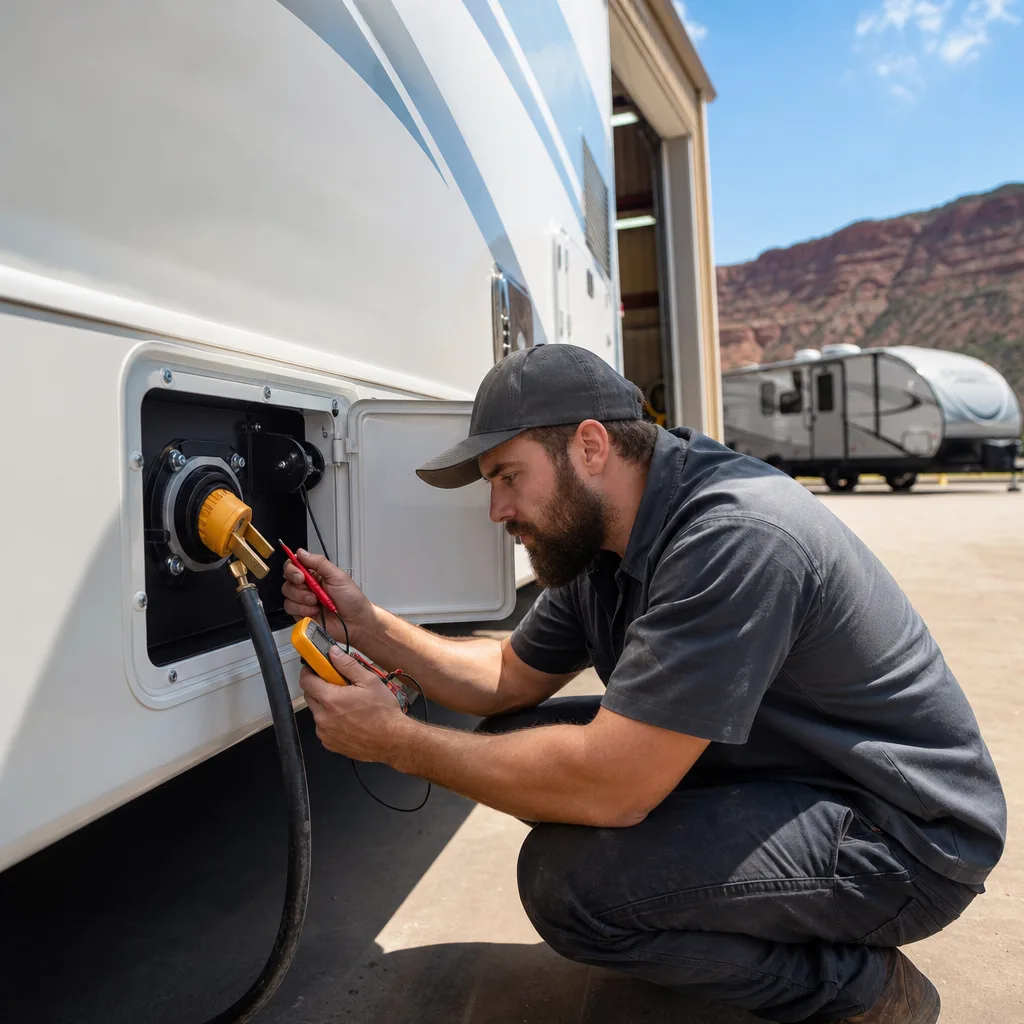
Pedestal Fault or RV Fault: How to Tell
Before anybody blames the RV, the park, or the guy parked next to you, figure out which side of the plug the problem lives on. The pedestal is the post with the breakers and outlets. Your side is everything from the plug in, including the cord, adapters, transfer switch, breaker panel, and converter. From inside the coach, a fault on either side can look about the same. The lights are out, the A/C is quiet, and the microwave is just staring at you.
These signs can point to the pedestal:
- The pedestal breaker is tripped or won't stay reset.
- Other sites on your row lost power at the same time.
- Your surge protector or EMS flags low voltage, reversed polarity, or an open ground before the RV is even connected.
- Your rig runs fine at a different pedestal or at home.
- The outlet looks scorched or worn, or your plug sags out of it like it's tired of holding on.
These signs can point to the RV:
- The pedestal checks out clean on your surge protector, but the coach still has no power.
- Power cuts in and out when you wiggle the cord, plug, or adapter.
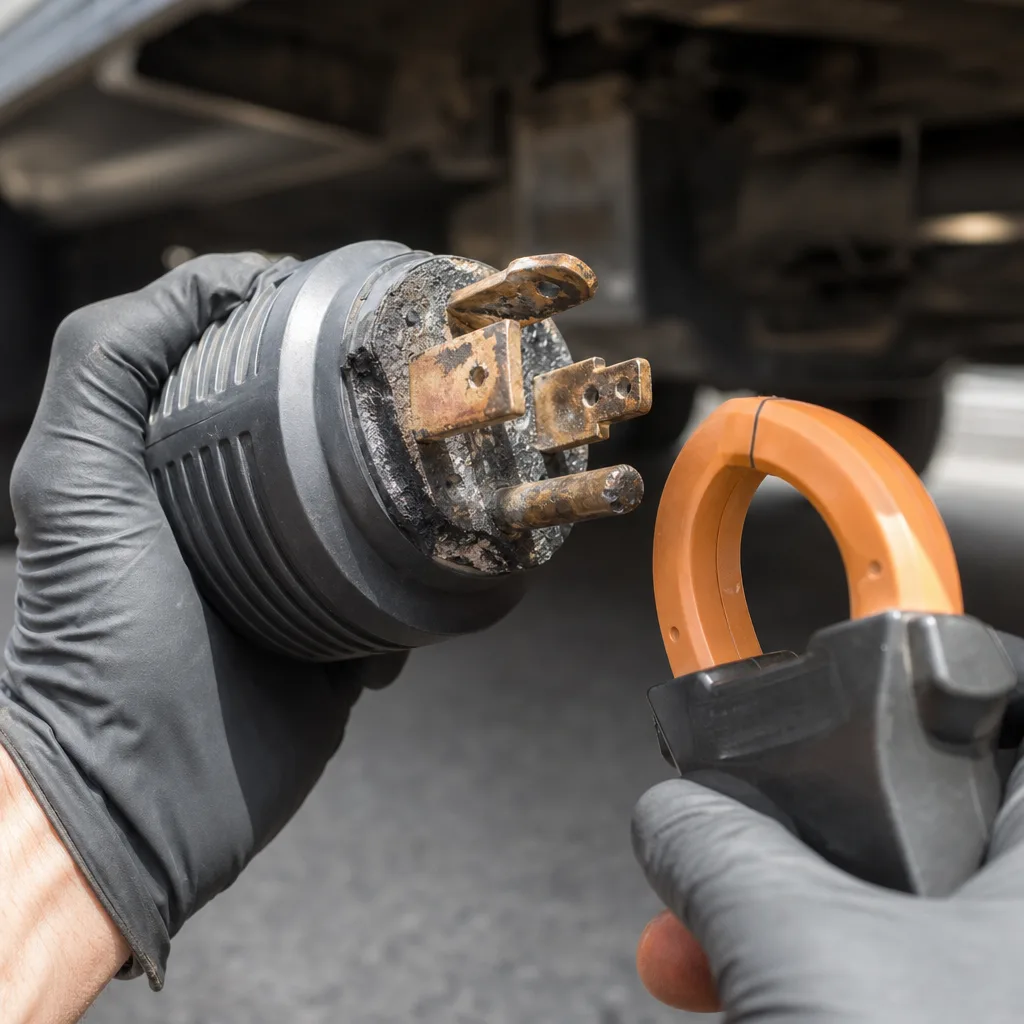
- The plug end or cord is discolored, melted, or warm after running a while.
- Breakers inside your panel keep tripping.
- The generator powers the coach fine, but shore power doesn't. That can point toward the transfer switch or the shore input side.
On a 50 amp rig, losing half the coach while the other half keeps running means one of the two legs dropped out. That one can come from either side, so it's worth a closer look rather than a guess.
Here's the simplest test we know, and it doesn't cost a dime: move. If the park has an open site, ask the office if you can plug in there for a few minutes. If the problem follows you to a new pedestal, it's traveling with you, which means it's in the RV. If the problem goes away, let the office know their post needs attention and enjoy being right.
One more thing before you call it a fault. If you've got a 30 amp rig plugged into a regular garage outlet with an adapter, some things will run and the A/C probably won't. That's not broken. That's physics. A household outlet can't feed what your coach was built to pull, and adapters only change the plug shape. They don't add power.
Scorch marks, a melted plug, or a hot plastic smell are a stop sign, not a puzzle. Quit using that connection until someone has looked at it.
Sometimes shore power is coming in fine, but your 12 volt lights and fans are still dead. That usually points past the plug to the converter, which we handle under RV Converter and Inverter Repair. Either way, knowing which side failed tells you whether to talk to the campground or to us, and it saves everyone a lot of head scratching.
Warning Signs That Mean Stop and Call Now
Most shore power problems are annoying. A few are dangerous. The trick is knowing which is which. A dead outlet can wait until you've had your coffee. A tingle from your door handle can't.
If you notice any of these, stop using shore power and get it looked at before you plug back in:
- You feel a tingle or a little zap touching the RV's metal skin, door handle, steps, or hitch. Folks call this a hot skin. It means current is going somewhere it shouldn't, and the next person to touch it might be your kid or your dog.
- Your surge protector or EMS shows high voltage, open neutral, or open ground, or it keeps cutting power on and off.
- Lights get very bright and then dim, or several things fail at once. Think the microwave, TV, and converter all quitting the same afternoon. On a 50 amp rig, a bad neutral can send the wrong voltage to one side of the coach, and electronics don't take that well.
- A breaker trips the moment you reset it, more than once. A breaker that keeps tripping is doing its job. Forcing it back on is like unplugging a smoke detector because it's loud.
- You hear buzzing, crackling, or humming from the panel, transfer switch, or plug, or you smell hot plastic inside the coach.
- The cord has a cut, crushed spot, or exposed wire, or the plug or adapter is sitting in water or snow.
Here's why these matter. Your RV is a metal box sitting on rubber tires. When the ground path is broken or a wire is rubbing through somewhere, the frame can become part of the circuit, and nothing tells you until somebody touches it. Heat is the other sneaky one. A loose connection makes heat, heat makes the connection looser, and that loop doesn't fix itself. It just gets hotter until something melts.
What to do in the meantime is simple. Don't keep resetting things to see if it sticks. Keep people and pets off the steps and away from the metal parts of the coach if you felt a shock. If the pedestal breaker is easy to reach and the area is dry, switch it off. If you're not sure, leave it alone and let the campground office know. Running on battery or generator for a night beats gambling with a bad connection.
Not every sign means the worst. A surge protector can flag a bad pedestal, and moving sites may solve it, which is why we covered telling the two sides apart first. But shock, heat, and wild voltage readings aren't the time to experiment. Those get checked before you plug in again, wherever the fault turns out to live.
Our Emergency Mobile RV Repair and On-Site Campground RV Repair services exist for nights like this. We come to the rig, so you don't have to tow a coach you don't trust. As an RVTI Certified Technician with 15+ years in the RV industry, we'd rather find a loose neutral now than hear about what it took out later.
Call nowUsing a 30-to-50 Amp Adapter Safely
Adapters are fine. Most of us carry one in the bay and forget about it until the park hands us the wrong post. The trick is knowing which way you're adapting, because those are two different jobs with two different sets of rules.
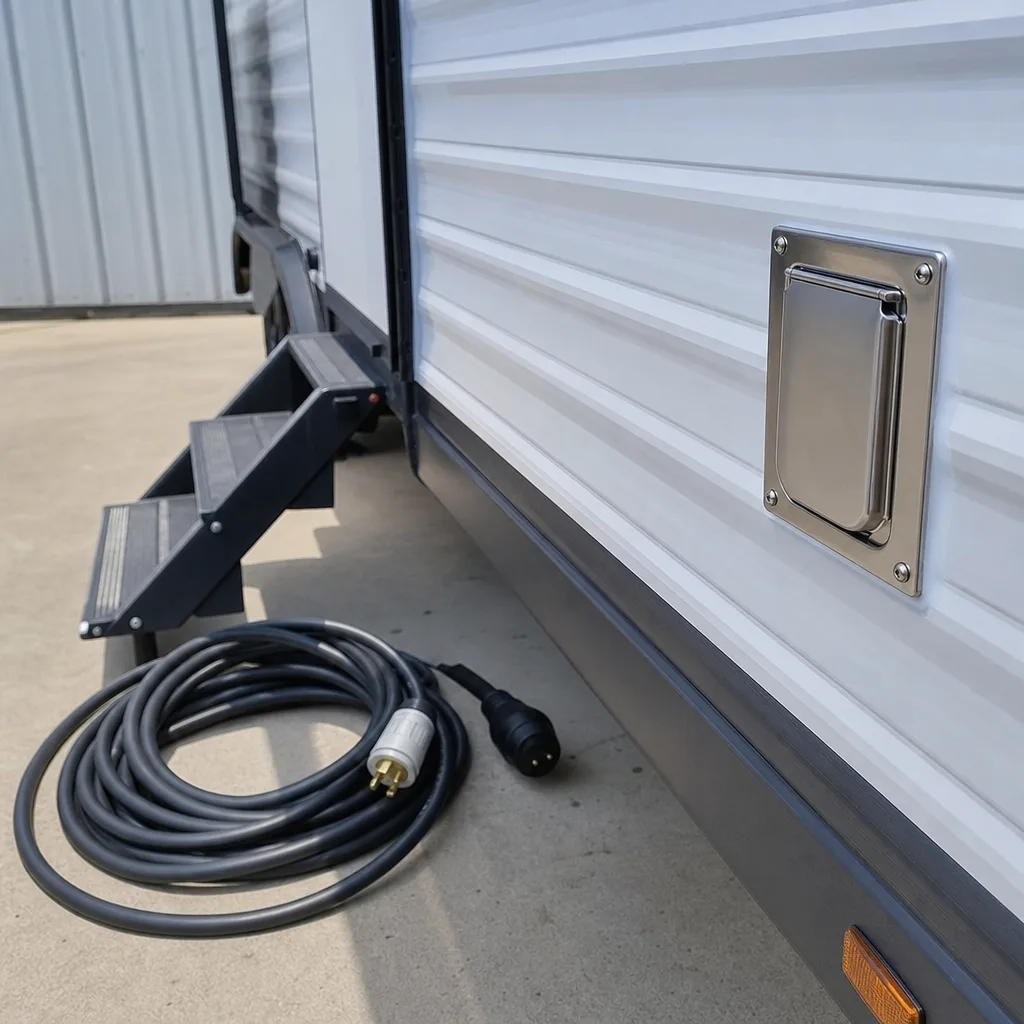
50 amp rig on a 30 amp pedestal. A 50 amp coach normally gets two separate 50 amp legs at 120 volts each. That gives you a lot of room. A 30 amp outlet has one hot wire. When you plug in with a dogbone adapter, both sides of your coach get tied to that one wire. Everything still turns on, but now the whole rig is sharing 30 amps, about 3,600 watts. Your panel doesn't know that. Every breaker inside still thinks it has plenty of room, so the pedestal breaker ends up being the only thing keeping count.
Here's how that plays out. It's a hot July afternoon. Both A/Cs are running and somebody starts the microwave. Then the coffee maker kicks on, and the pedestal breaker clicks off. Everyone blames the park. Nothing's broken. You just ran out of amps.
- Run one A/C, not two. A single roof unit can eat a big piece of that 30 amps by itself.
- Switch the water heater and fridge to propane if they can run on it.
- Let the A/C settle before you start the microwave, hair dryer, or electric kettle. Take turns, like kids with the TV remote.
- If the pedestal breaker trips, turn something off before you reset it. Resetting into the same load just trips it again and wears out the breaker.
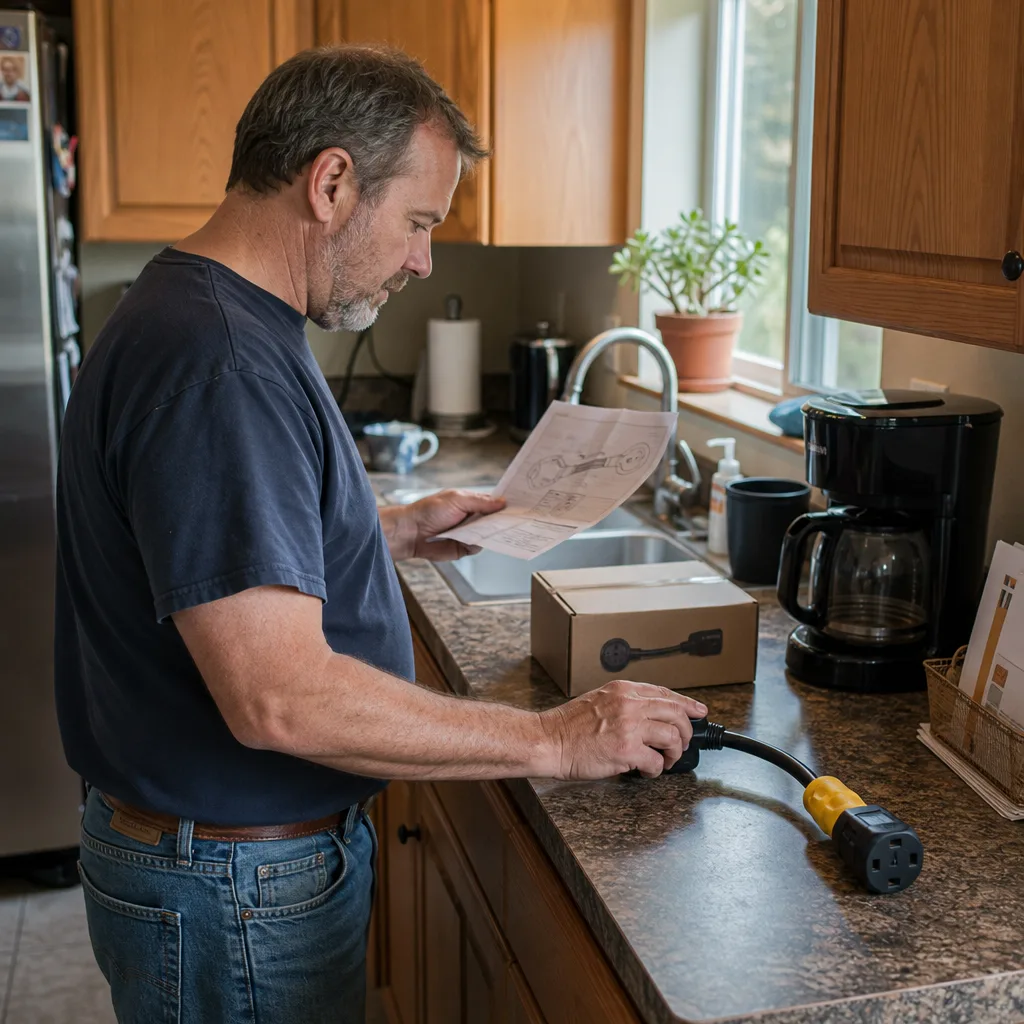
30 amp rig on a 50 amp pedestal. This direction is easier. Your coach can only pull what its own 30 amp main breaker allows, so a bigger outlet won't give you more power. But it won't hurt anything either. Use a proper 30 amp female to 50 amp male adapter, and you're good to go.
There's one adapter mistake that really costs people. Never plug a 30 amp RV into a home dryer outlet with an adapter. Dryer outlets are 240 volts. Your 30 amp coach is built for 120. Put twice the voltage through it, and you can take out the converter, the microwave, and the TV all at once. The adapter will fit, and that's the problem. A plug fitting doesn't make it safe.
Good adapter habits:
- Turn the pedestal breaker off before you plug in or unplug. Pulling a plug while power is flowing makes a spark that slowly burns the metal contacts.
- Buy a solid adapter with a pull handle, a heavy cord, and a clear amp rating. Unmarked bargain adapters are where cheap shortcuts hide.
- Use one adapter at a time. Every connection you stack on top of another is one more spot for heat to build.
- Push the plug all the way in. A plug that's only partway in is how a melted plug gets started.
- Keep connections off the ground and out of puddles and snow.
- Put your EMS right at the pedestal, so it reads what the park is sending you.
- After an hour of A/C, put your hand on the adapter. Warm is normal. Too hot to hold is one of the stop signs we covered above.
If an adapter shows brown or melted spots, throw it out. Then check the plug and the RV's power inlet, because heat travels to the next connection down the line. A new adapter won't fix a burned power inlet on the RV. It'll just be the next part to cook.
What a Shore Power Inspection and Repair Covers
Once you know the problem lives on your side of the plug, the real job starts. A good shore power inspection follows the power the same way electricity does, one connection at a time from the plug to the breakers. That matters because the part that looks bad usually isn't the whole story. A melted plug is a symptom. The question is what made it hot.
Here's what a thorough check should cover:
- The shore cord and plug. Look for cracks, flat spots, and stiff sections, and check the plug blades for pitting or brown marks. A cord that's been run over or pinched in a slide-out can look fine on the outside and still be damaged inside.
- The power inlet on the RV. On a lot of rigs, this is the outside receptacle where the cord plugs in. If an adapter or plug has cooked before, the inlet often took some of that heat too. Replacing the cord and leaving a scorched inlet just moves the problem down the line.
- The transfer switch. This is the box that picks between shore power and generator. Its contacts can burn or stick, and its wire connections can loosen. That's the usual suspect when the generator runs the coach but shore power won't.
- The main breaker panel. Every lug and screw terminal should be tight, and every breaker should be checked for heat damage or a weak trip. A loose screw in a panel can make more trouble than a lot of bigger-looking problems.
- Neutral and ground. These two wires are where hot skin and odd voltage readings come from, so they need a real test, not just a look.
- Both legs on a 50 amp rig. Each leg should carry its own load and its own correct voltage, all the way through the system.
- Any hardwired surge protector or EMS. If one is built into the coach, it's part of the power path and can fail like anything else.
Why so much ground to cover for one dead outlet? RVs bounce down the highway for a living. Connections that were tight at the factory loosen a little every trip, and a loose connection is exactly where heat starts. A real repair finds the loose one and fixes it. Then it checks the connections on each side of it, because heat doesn't stay put.
Once the cause is found, the fix is often less dramatic than you'd think. It might be a new plug end, a new inlet, transfer switch contacts or the whole switch, a tightened or replaced lug, or one tired breaker. Sometimes it's a damaged run of wire that needs to be fixed properly, not wrapped in tape and hoped for. If shore power checks out but your 12 volt side is still dead, that points to the converter. We handle that under RV Converter and Inverter Repair.
Because shore power repair is one of the services we bring to you, the rig can usually stay where it's parked, whether that's your driveway, a storage lot, or a campsite. That beats towing a coach you're not sure is safe to plug in. One heads-up: we don't currently do manufacturer warranty work. If your rig is still under the factory warranty, check with your dealer first.
When You Don't Need a Repair
Plenty of shore power calls end with a switch, not a part. We'd rather you find that out before we drive over. Here are the common ones that look like a repair and aren't.
Only a few outlets are dead. If the bathroom, kitchen, or outside outlets quit but the A/C and lights still run, look for a GFCI outlet. That's the one with the little test and reset buttons. On a lot of rigs, one GFCI protects several other outlets down the line, and it's often tucked somewhere you'd never guess, like the bathroom or behind a cabinet door. Find it, press reset, and you're done. If it trips again right away, that's a real fault, and you're back in stop sign territory.
The whole coach is dead after storage. Check the main breaker in your panel before anything else. Breakers get bumped, and some folks flip the main off when they park the rig for winter and forget by spring. It happens to people who've owned RVs for 30 years. Nobody needs to know.
Your EMS is taking its time. Many units have a built-in wait of a minute or two before they pass power through. That pause is on purpose. It's checking the pedestal before it trusts it. Give it a couple of minutes before you decide something's broken.
The whole park is running low. On a hot afternoon when every rig on the row has its A/C going, the park's voltage can sag. Your EMS may cut power to protect your gear, then turn it back on when things settle in the evening. That's not your RV. That's a park problem, and the office needs to hear about it. The same goes for anything the pedestal test from earlier points back at the post.
A breaker tripped once when too much was running. If it reset and held after you turned a few things off, the breaker did its job. One trip on a busy afternoon isn't a repair. A breaker that trips every time, no matter what's running, is.
Shore power is fine but the 12 volt lights are out. On many rigs, a battery disconnect switch near the entry door cuts the house 12 volt circuits. If someone flipped it off, the coach feels dead even though shore power is coming in just fine. Flip it back on before you start blaming the converter.
Your cord just looks old. Faded color and a few scuffs don't mean it's bad. If the jacket isn't cracked or crushed, and the plug stays clean and cool after a long run with the A/C on, it can keep working. You don't need a new cord because it has some miles on it.
And if you're on a regular garage outlet and the A/C won't run, that's the outlet's limit we talked about earlier, not a fault.
None of these need us. If you've checked them all and the coach is still dark, or something keeps coming back, that's when it's worth a closer look.
Call nowFrequently Asked Questions
What should I look for in a 50 amp to 30 amp RV adapter?
Look for a solid adapter with a pull handle, a heavy cord, and a clear amp rating stamped on it. Skip unmarked bargain adapters, since that's usually where cheap shortcuts and loose contacts hide. A good dogbone adapter should feel heavy for its size and plug in snugly with no wiggle. If the blades look thin or flimsy, it will heat up faster under a real load like an A/C running on a hot afternoon.